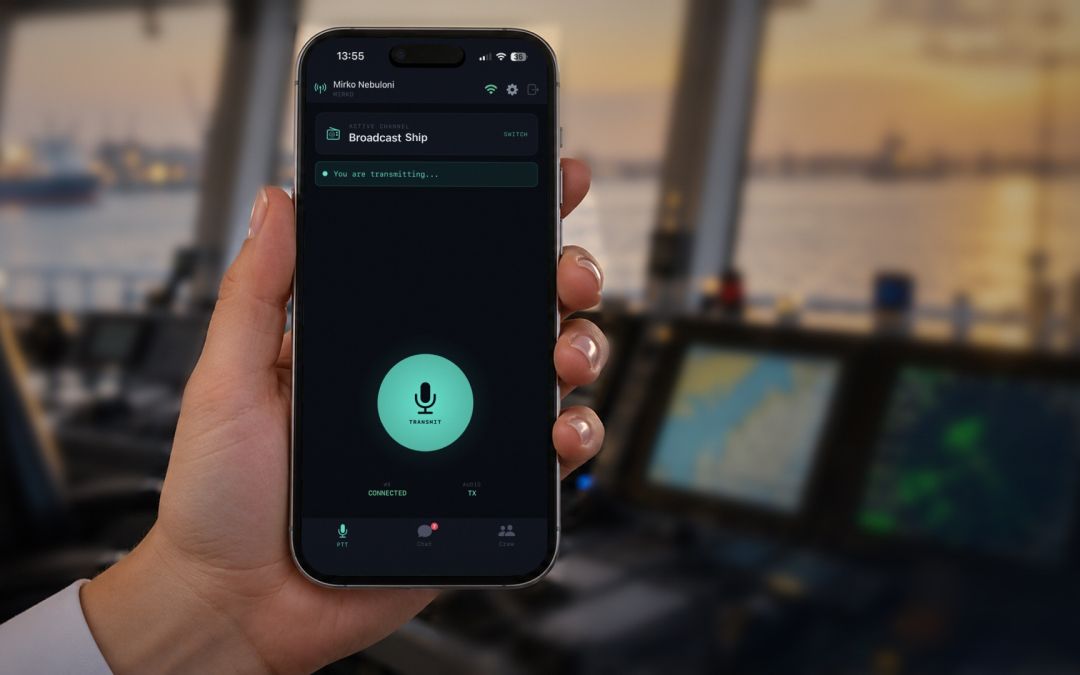
Seafy is introducing Seafy P2T (Push-to-Talk), a system designed for operational communication between crew members. The solution turns smartphones into push-to-talk devices connected to the vessel’s existing Wi-Fi network.
Bridge, engine room, deck and other departments can communicate through dedicated channels even when the vessel has no internet connection.
On board, Seafy P2T works entirely offline. When external connectivity is available, communications can also extend to other vessels in the fleet and to the shipping company’s shore-based teams, enabling continuous coordination between ship and shore.
Also read: Miscommunication results in ship hitting mooring dolphin
Internal operational communication
P2T addresses one of the most common operational needs on board: enabling crew members working in different areas of the vessel to communicate quickly and efficiently. The system does not replace the radio equipment or safety communication systems required on board, such as VHF and GMDSS. Instead, it provides an additional layer for internal operational communication.
The architecture is based on a server physically installed on board, which manages voice communications, users and channels locally. This allows the system to remain operational throughout navigation while enabling crew members to use devices they already carry rather than requiring an additional radio handset for every user.
Priority levels
Through the iOS and Android app, crew members can access the channels assigned to their department, use push-to-talk communication and exchange messages within an environment controlled by the shipping company.
Voice transmission is initiated in under 100 milliseconds, while talk management prevents simultaneous transmissions from overlapping on the same channel. Different priority levels are also supported, including high-priority communications that can override an ongoing transmission when required.
Also read: ‘Communication is key during mooring’
Traceability
Traceability is another key element of the system. P2T does not record the audio of conversations. Instead, it stores activity logs locally on the vessel’s infrastructure, including user access, channel activity and transmissions. These records can be reviewed through the management dashboard, providing shipping companies with a history that can support internal monitoring and documentation processes.
Communications are protected, and every access is linked to an authorised user. Identities, roles and permissions can all be managed centrally.
Vessel-based licensing
The licensing model is vessel-based rather than user-based. P2T is licensed per vessel, regardless of the number of individual crew members using the system within the selected configuration.
Three configurations are available, covering requirements ranging from yachts and cargo vessels to passenger ships, cruise vessels and larger fleets, with support for up to 1000 users per vessel. An annual maintenance service is also available.
Picture: Seafy P2T uses smartphones to allow crew to communicate with each other (image Seafy).
Also read: Dutch student wins award with visual communication method for heavy-lift vessels