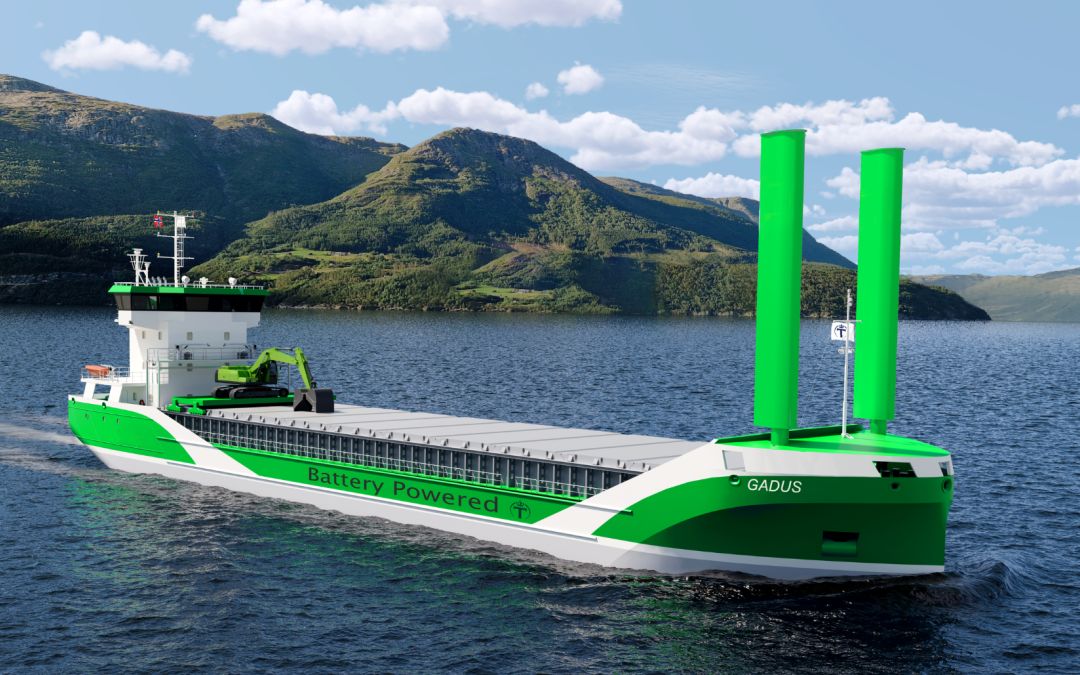
Royal T Shipyards is further advancing the fully electric version of its GADUS dry cargo vessel series. Developed for shipowners operating in the 5000–6000-tonne deadweight segment, the GADUS Battery Electric is intended for zero-emission short-sea and coastal cargo operations.
Rather than starting from a blank sheet, the vessel builds on the same design philosophy, Dutch shipbuilding expertise and practical experience behind Royal T Shipyards’ existing GADUS series.
The GADUS vessels are designed and engineered in-house, with the hulls constructed in the Netherlands. Throughout the development and construction process, Royal T Shipyards works closely with a network of trusted suppliers and co-makers. Their early involvement supports reliable system integration, practical engineering and control over quality throughout the complete vessel.
The first vessel in the series, Hav Leiti, was delivered to Navigare Shipping in 2026. It is the lead vessel in a four-ship programme and demonstrates the platform’s cargo efficiency, operational flexibility and integrated electric architecture in everyday short-sea operations.
Also read: Royal T christens first GADUS 5900 vessel
Shore power and data management
Hav Leiti combines a high-cubic cargo hold with diesel-electric propulsion and an electric self-discharging system comprising an electrically driven excavator mounted on a travelling traverse. A multi-input shore-power transformer enables the excavator and other onboard systems to operate on shore power, allowing emission-free and low-noise cargo discharging in ports wherever suitable shore-power facilities are available.
The GADUS platform also incorporates a Vessel Data Management System that collects and processes selected operational information from the vessel’s navigation, propulsion, machinery, alarm and automation systems. Shore-based dashboarding provides the owner and vessel manager with access to crucial vessel information, supporting operational optimisation, performance analysis, informed decision-making and more effective maintenance planning.
Also read: Royal T launches second LABRAX for Carisbrooke
To full battery-electric operation
The GADUS Battery Electric takes the next step by replacing conventional onboard energy generation with a large-scale battery installation. The vessel’s intended route, operating profile, cargo requirements and available charging infrastructure determine the configuration.
By retaining the proven principles of the GADUS platform, Royal T Shipyards can combine full battery-electric propulsion with the characteristics required for practical commercial operation in the 5000–6000-tonne deadweight segment: substantial cargo capacity, efficient hull lines, a flexible cargo hold and robust equipment for frequent coastal trading.
‘Zero-emission shipping must work not only technically, but also operationally and commercially,’ says Thecla Bodewes, CEO of Royal T Shipyards. ‘With the GADUS Battery Electric, we are building on a Dutch-built vessel platform that has already progressed from in-house design to series construction and operation. Together with our trusted suppliers and co-makers, we can focus the next development step on optimising the complete energy system for the owner’s actual trading profile.’
Also read: Royal T christens first GADUS 5900 vessel
Operational analysis
The GADUS Battery Electric has been developed to retain the cargo capacity and operational flexibility required for commercial coastal dry cargo transport. Royal T Shipyards has supported detailed operational and energy-use studies covering complete route profiles, sailing distances, port calls, cargo requirements, charging opportunities, weather allowances and onboard energy consumption.
For the analysed Norwegian trading profile, these studies validated battery-electric missions of up to approximately 450 nautical miles while maintaining the required cargo-carrying capability. Depending on the complete operating cycle and available charging infrastructure, up to 91 per cent of the vessel’s operation could be performed on electricity. This corresponds to an estimated annual reduction of approximately 1540 tonnes of CO2 compared with conventional operation.
Final battery capacity, installed power and charging configuration are determined for each project on the basis of the owner’s actual trading profile. Royal T Shipyards therefore focuses not on installing the largest possible battery, but on finding the most effective balance between payload, sailing speed, range, charging time, operational reserve, redundancy and lifecycle cost.
Also read: Royal T designs ships for zero-emission coastal transport
Designed around the owner’s operation
The modular diesel-electric design knowledge applied across Royal T Shipyards’ GADUS, LABRAX and SALMO vessel series provides a strong foundation for integrating batteries and other future energy sources.
Depending on the route and operational requirements, the GADUS platform can be configured for fully electric propulsion or for a battery-dominant arrangement with an alternative backup or range-extending energy source. Space allocation, weight distribution, electrical integration, charging capacity and future system expansion are incorporated from the earliest design phase.
Also read: Royal T delivers new Salmo vessel MV Sueve
GADUS platform at SMM Hamburg
Royal T Shipyards will present the GADUS platform at SMM Hamburg from 1–4 September 2026. At its stand, the shipyard will display a detailed model of Hav Fles. This is the sister vessel of Hav Leiti and the second vessel in the four-ship GADUS series for Navigare Shipping. The model provides a tangible view of the proven, Dutch-built vessel platform behind the GADUS Battery Electric.
Picture: The GADUS Battery Electric (image by Royal T Shipyards).