
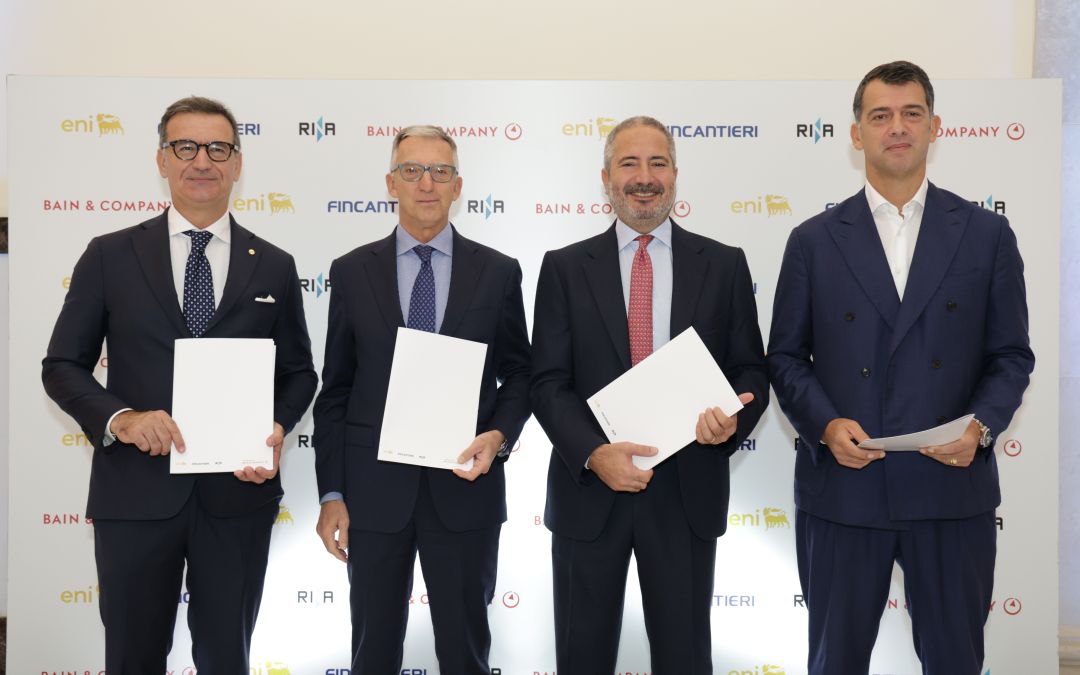
Eni, Fincantieri and RINA have presented the second edition of the Sustainable Maritime Transport Outlook. The key message emerging from their research is that the landscape is more uncertain than it was a year ago.
The transition is not progressing at the same pace everywhere. The main divide is not technological, but regulatory: while Europe is driving decarbonisation through binding measures, the lack of clear obligations and incentives at global level is holding back investment by shipowners. There is no single solution: LNG and biofuels are already viable options for the short and medium term, while synthetic fuels will be essential to meet the 2050 targets.
However, competitive solutions are already available to reduce environmental impact today, offering a pragmatic response to the European regulations currently in force while the industry awaits global decisions from the IMO.
Also read: RINA unveils Mermaid, a future-ready ship design
Sustainable Maritime Transport Outlook
Eni, a global energy company, Fincantieri, which builds high-complexity ships, and classification society RINA presented the second edition of the Sustainable Maritime Transport Outlook on 11 November in Rome, Italy. It was developed with the technical support of Bain & Company Italy.
The Outlook provides a global overview of solutions for decarbonising maritime transport, comparing different technology and fuel options in terms of their emissions reduction potential, maturity, infrastructure availability and the evolution of their total cost of ownership through to 2050.
The quantitative analysis is supported by a broad range of interviews with operators and stakeholders across the value chain, including shipowners and operators representing around forty per cent of the container market and twenty per cent of the cruise market, engine and propulsion technology suppliers accounting for more than eighty per cent of the ICE market, as well as ports and industry associations. Together, these interviews provide a clear picture of market realities.
3 of 4 indicators shaping the transition have deteriorated
Under the Outlook’s reference scenario, “Today as Future”, Europe is expected to achieve an eighty per cent reduction in emissions intensity by 2050 compared with 2020 levels, while the reduction globally is projected at around forty per cent. The Outlook also considers a slower scenario, “Decarbonization by 2070”, under which the achievement of Europe’s decarbonisation targets is postponed until 2070, with countries in the rest of the world following several years later.
Compared with last year, three of the four indicators shaping the transition, namely the regulatory framework, macroeconomic conditions, fuel and infrastructure availability, and technological maturity, have deteriorated, with regulatory uncertainty having the greatest impact. The global IMO agreement has been postponed and, when countries are weighted by tonnage, almost ninety per cent support a more gradual pathway, while the United States has taken a position against maritime decarbonisation. Europe, by contrast, has reaffirmed the targets already established under FuelEU Maritime.
Also read: Eni, Fincantieri to enhance underwater monitoring tech
Economic outlook uncertain
The economic outlook has also become more uncertain due to slowing growth, tariffs and geopolitical tensions, while the crisis in the Strait of Hormuz is increasing risks to trade flows and the global economy. The low-emission hydrogen value chain has lost momentum, with numerous maritime projects put on hold.
Technology nevertheless continues to play an enabling role, with the orderbook for alternative-fuel vessels growing slowly but steadily. However, against a backdrop of uncertainty, shipowners are increasingly favouring mature, readily available solutions.
Synthetic fuels produced from green hydrogen will be essential to complete the pathway to net zero, but they remain expensive and depend on a supply chain that has yet to be fully developed.
Biofuels and LNG
Eni sees HVO biofuels, alongside LNG and bio-LNG, as important tools for decarbonising shipping using existing vessels and infrastructure. It calls for stable regulations to encourage investment. Fincantieri takes a flexible approach to ship decarbonisation, combining LNG, bio-LNG, e-LNG, HVO and dual-fuel propulsion with improved energy efficiency, while also researching future options such as nuclear technology.
RINA supports maritime decarbonisation by helping operators assess the maturity, feasibility, environmental performance and regulatory compliance of different technologies and solutions.
Also read: Shell: Global LNG demand to rise 65 per cent by 2050
Building platforms that can evolve
The Outlook sets out concrete commitments for every player across the value chain: common rules and standards for regulators and certification bodies; targeted investment and flexible infrastructure for ports; availability and diversification for fuel suppliers; vessels designed to accommodate multiple solutions and retrofit support for shipyards and shipowners; and continued investment in research and development by engine manufacturers. Pragmatism does not mean waiting: it means starting with mature technologies while building platforms that can evolve over time.
Against the backdrop of an increasingly complex geopolitical environment, Eni, Fincantieri and RINA also formalised their commitment during the event to continue the Observatory’s work for the next three years.
Cost landscape
The cost landscape changes over time in Europe, where progressive decarbonisation targets are underpinned by a system of increasing penalties. In 2030, fossil fuels remain the most cost-effective options, while synthetic fuels can cost around three times as much. From 2040 onwards, European emissions penalties make biofuels increasingly competitive, and by 2050 fossil fuels could cost around twice as much as the more sustainable alternatives.
Looking at Europe’s fuel mix in 2050, there is no single clear winner, but a well-defined backbone emerges: biofuels will account for around one third of the mix, alongside fossil and bio-LNG, while synthetic fuels will contribute around twenty per cent to the decarbonisation pathway. Overall, this will result in an eighty per cent reduction in GHG emissions compared with 2020 levels.
Also read: Fincantieri launches world’s first hydrogen cruise ship
Slower uptake of synthetic fuels
Compared with the previous edition, the overall direction of the transition remains unchanged, but the projected contribution of synthetic fuels has been reduced by around half. As a result, the investment required to upgrade European port infrastructure is also lower: approximately USD 15 billion, compared with the roughly USD 25 billion estimated last year, with the entire difference attributable to the slower uptake of synthetic fuels.
At global level, the transition is expected to progress more slowly. By 2050, the global fuel mix will still rely significantly on conventional fuels, which will account for around seventy per cent of the total, while GHG emissions reductions will reach only around forty per cent compared with 2020 levels. In Europe, by contrast, biofuels and LNG will remain the main areas of convergence with the rest of the world, albeit within a faster emissions reduction pathway.
E-LNG for cruise ships and nuclear propulsion to enter the stage
In the cruise sector, which is of strategic importance to the Italian shipbuilding industry, synthetic fuels are expected to play a greater role than in maritime transport overall. This will primarily involve e-LNG, which could help decarbonise LNG-powered vessels already in the fleet while making the most of investments already made in existing platforms.
Although nuclear propulsion is not expected to make a significant contribution to the 2050 decarbonisation pathway, the first nuclear-powered vessels could enter service between 2040 and 2045. Over the longer term, nuclear could also emerge as a key technology for certain high-power, long-range segments. This makes it important to begin research, assessment and development activities in this field today.
Coordinated action across the value chain
Decarbonising maritime transport requires cooperation across the value chain. Key barriers include regulatory uncertainty, difficulty passing on the cost of cleaner fuels and onshore infrastructure bottlenecks. Progress depends on stable global regulations, clear price signals, predictable demand, reliable fuel supplies and diversified feedstocks.
Picture: Paolo Moretti, Chief Executive Officer and General Manager of RINA; Giuseppe Ricci, Chief Operating Officer, Industrial Transformation at Eni; Pierroberto Folgiero, Chief Executive Officer and General Manager of Fincantieri; Pierluigi Serlenga, Managing Partner for Italy and South & Eastern Europe at Bain & Company (photo Eni).