Mounting or dismantling heavy covers should always be carried out by two persons, warns The Nautical Institute in a new Mars Report. The report describes how a crew member was injured while working with a hatch cover.
The Nautical Institute gathers reports of maritime accidents and near-misses. It then publishes these so-called Mars (Mariners’ Alerting and Reporting Scheme) Reports (anonymously) to prevent other accidents from happening. This is one of these reports.
During planned maintenance, an engine crew member was attempting to close an under-piston inspection hatch cover on the main engine. Nearby crew saw him struggling and asked if he needed help, but he waved away their offer and continued to work alone.
Although proper personal protective equipment was used, the heavy cover (28.5 kg) slipped and fell onto the victim’s hand. First aid was applied immediately, with follow-up medical treatment and monitoring, and the victim ultimately recovered.
Also read: ‘Crew should carry out on-site risk assessments to avoid unnecessary injury’
Investigation findings
The company investigation found, among others, that the hazard posed by the heavy inspection cover was not identified in the risk assessment or toolbox talk. The requirement for two-person lifting was not specified. Lack of warning signage near the cover contributed to unsafe practices.
Also read: ‘STOP work’ doesn’t translate well and results in MOB fatality
Advice from The Nautical Institute
- Heavy covers always should be dismantled and mounted by two persons, regardless of whether crew members are using a chain block or not.
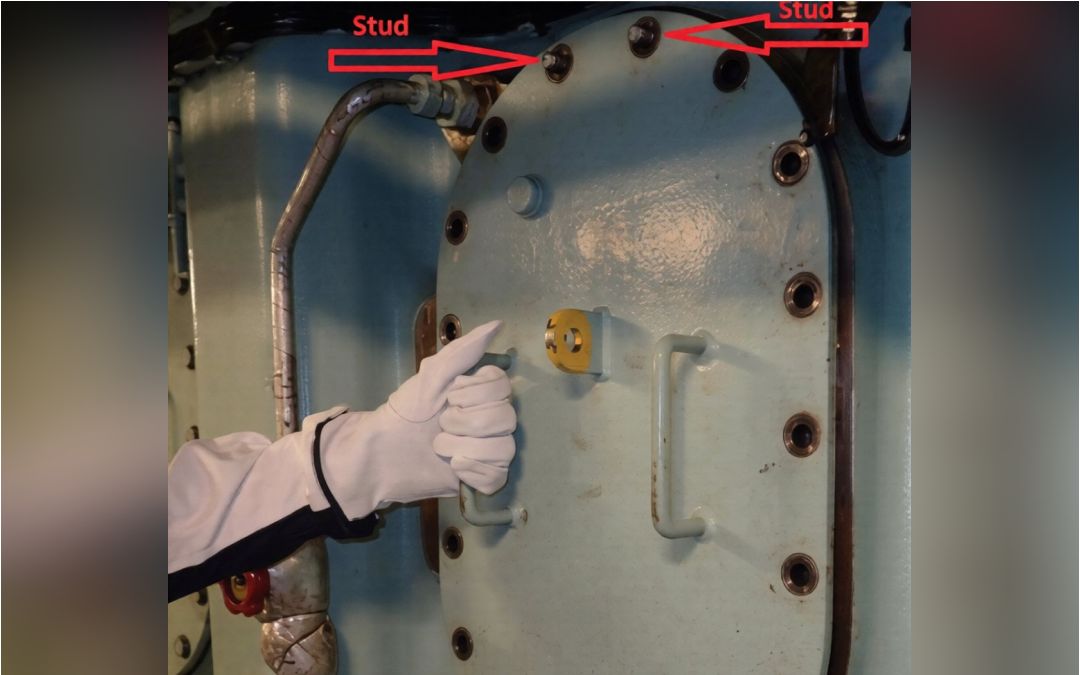
- Ideally, there should be two long studs mounted at the top position of every cover to keep it in position during dismantling/mounting.
- Work permits and toolbox talks should reinforce safe lifting techniques and roles to prevent solo handling.
- Stop work authority should be exercised by all crew if perceived unsafe actions are observed.
- Supervisory presence is crucial during potentially hazardous tasks.
Also read: LOTO failure leads to injury
Mars Reports
This accident was covered in the Mars Reports, originally published as Mars 202630. A selection of the Mars Reports are also published in the SWZ|Maritime magazine. The Nautical Institute compiles these reports to help prevent maritime accidents. That is why they are also published (in full) on SWZ|Maritime’s website.
More reports are needed to keep the scheme interesting and informative. All reports are read only by the Mars coordinator and are treated in the strictest confidence. To submit a report, please use the Mars report form.
Picture: Suggested risk reduction measure – upper studs as anchors (photo The Nautical Institute).