

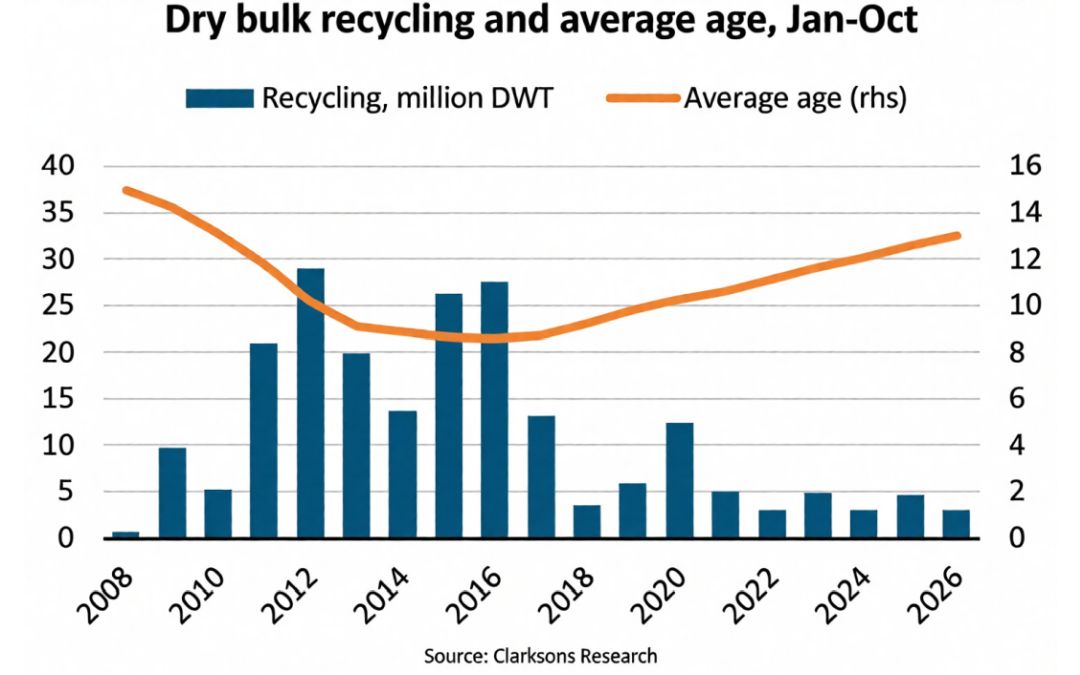
There has been a decline in dry bulk ship recycling as strong freight rates have helped extend the operational lives of the fleet. BIMCO discusses this development in a new “Shipping number of the week”.
‘Between January and October 2026, dry bulk ship recycling fell 36 per cent y/y to 3m DWT, its lowest level in eighteen years,’ says Filipe Gouveia, Shipping Analysis Manager at BIMCO. ‘Only seventy ships were recycled, primarily smaller ships in the handysize and supramax segments, as strong freight rates have extended the operational lives of older ships.’
Dry bulk ship recycling has been at a low level since 2021 due to strong freight rates. Several disruptions have tightened the supply/demand balance. These include high congestion in 2021, longer sailing distances due to sanctions on Russian coal, which caused ships to be rerouted away from the Red Sea, and growing shipments from the Atlantic to Asia.
More recently, strong investment in AI has supported electricity demand, coal consumption and global economic growth, helping the market withstand headwinds from changes in US trade policy and disruptions in the Strait of Hormuz.
Also read: China continues to lead global order book
Significant overhang
Gouveia: ‘Following several years of low ship recycling levels, a significant overhang has built up. We estimate that if ship lifecycles had remained in line with those observed between 2000 and 2019, an additional 856 ships, totalling 61m DWT, would have been recycled by now. That is equivalent to six per cent of the current fleet capacity. As ships remain in service for longer, the dry bulk fleet has gradually aged, with the average bulk carrier now over thirteen years old, compared with an average of ten years at the start of the decade.’
The recycling overhang is increasingly visible in the age profile of the fleet. There are now 1035 dry bulk ships, totalling 46.7m DWT, which are more than 25 years old. These are equivalent to seven per cent of ships and four per cent of fleet capacity.
The share of older capacity is highest in the handysize and panamax segments, at eight per cent each, compared with five per cent for supramax. By contrast, only eleven capesize ships are more than 25 years old, since capesizes typically have shorter lifecycles.
Also read: Container fleet set to reach new high of 34 million TEU
Supply/demand balance to weaken
In BIMCO’s latest Dry Bulk Shipping Market Overview & Outlook, the organisation forecast the supply/demand balance to gradually weaken in 2027 and 2028, albeit from a high baseline. Ship deliveries are expected to accelerate, growing nineteen per cent in 2027 and a further four per cent in 2028. The increase will be driven by the capesize segment, following higher contracting in recent years.
‘As market conditions gradually weaken, freight rates could soften, making it less attractive to keep older ships operating. Consequently, we estimate ship recycling could increase to 5.5m DWT in 2027 and 9.2m DWT in 2028, which would be the highest since 2020. Nevertheless, even with this increase, recycling levels would be low compared with the highs seen during the 2010s and an overhang of older ships would remain,’ says Gouveia.
Image BIMCO.
Also read: ‘Suez Canal container traffic passes 50% recovery mark’