ShoreLink has introduced TankerLink, a new product line of cable management systems that can connect all types of tankers to shore power. The solution takes into account the operational, safety and infrastructure constraints specific to tankers.
In 2025, tankers emitted 2.72 million tonnes of CO2 at berth in European Economic Area ports. That’s almost a third of all CO2 emitted by ships at berth, and about 1.6 times more than container ships. Yet, the EU’s shore power requirement from 2030 covers only container and passenger ships of 5000 GT and above.
‘With 33.8 per cent of the global merchant fleet capacity in tankers, shore power can’t stop at cruise ships, ferries and container vessels,’ says Kaupo Läänerand, Chief Commercial and Strategy Officer at ShoreLink. ‘TankerLink brings what we’ve learned from connecting those ships to the tanker segment, and our first tanker projects in Europe and South America are already under way.’
Also read: EU financing for Rotterdam Shore Power
Safety concerns
Tanker adoption of shore power has been slow, with safety remaining the primary concern. Every tanker berth is different: the connection point may be at the stern or midships, the distance from the jetty can be long, and parts of the vessel are classified as hazardous (ATEX) zones. The situation is even more challenging because berths and jetties are different globally and for the most part, they were never designed to support shore power.
Priit Saar, Lead Engineer of TankerLink Reach at ShoreLink: ‘The individual technologies were already part of our portfolio. The challenge was integrating them into a solution designed for tankers, which come with their own operational, safety and infrastructure constraints. Combining proven technologies into a practical and reliable system took extensive engineering and validation.’
TankerLink Reach
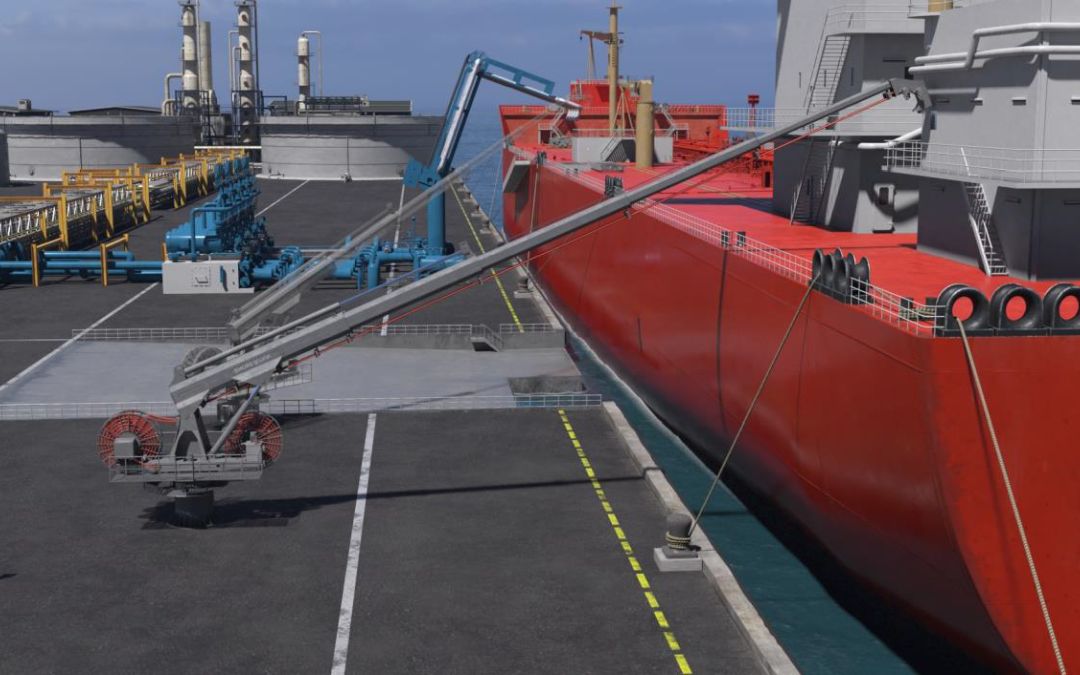
TankerLink Reach is a separate telescopic unit that connects at both stern and midship positions. The boom rotates up to 220°, and the largest current version has a working range of up to 40 metres. Connection and disconnection take minutes. The unit is fully radio-controlled, minimising the need for personnel on the quay, while the Active Height Compensation System automatically adapts to the vessel’s movement.
Saar: ‘Different ports and vessels need the connection in different places. Stern connections often offer operational advantages and simpler integration, but some terminals need a midship connection. That’s why we designed TankerLink Reach to support both.’
Also read: ‘European ports must do more to meet shore power targets’
TankerLink LongLine
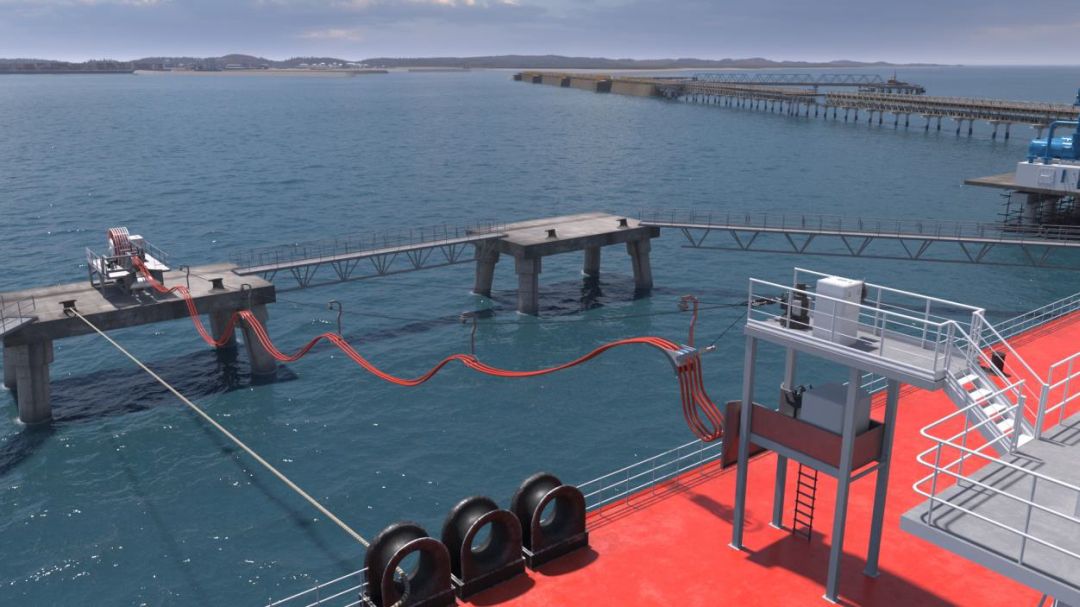
TankerLink LongLine is a highline-type cableway for berths where the distance to the vessel is too long for a conventional system. A tensioned support line carries the power connector to the vessel’s stern, outside its ATEX zones, over a working range of up to 55 metres.
LongLine uses festoon and rope-based cable handling, an established principle in portal cranes and in ship-to-ship transfers at sea. Three power cables connect through standard plugs and sockets. The system also suits vessels that need a longer-term connection, such as FSRUs. It means less manual handling of heavy high-voltage cables and less exposure for personnel. If the vessel has to leave in an emergency, a Quick Release Hook disconnects it quickly and in a controlled way.
The systems serve different operational priorities. Reach offers a high level of automation, speed and ease of use. LongLine is designed for longer port stays, providing a reliable connection over greater distances and restricted installation areas.
Low and medium voltage
Both systems are designed in line with IEC/IEEE 80005 and work at low voltage (400/440/690 VAC) and medium voltage (6.6/11 kV) at 50/60 Hz, with power up to 13 MVA for LongLine and 12 MVA for Reach. Both Reach and Longline have been designed according to the OCIMF guidelines.
ShoreLink designs and manufactures its cable management systems and automated/charger connectors in Estonia, combining in-house engineering expertise with a strong focus on reliability and operational performance. The company’s solutions have been deployed across eighteen countries.
Picture (top): TankerLink Reach connects at both stern and midship positions (image ShoreLink).
Also read: ABB wins world’s largest shore power project in Rotterdam