From the magazine – There is something peculiar about the energy transition. We expect technologies that have barely entered the market to compete on price with systems we have spent a century perfecting. When they fail to do so, we wonder whether they have a future. Meanwhile, delaying the transition seems to require far less justification.
Vera Terlouw describes how Allseas has completed the concept design for its nuclear reactor and is moving towards detailed engineering. Yet, her most revealing observation concerns everything surrounding the reactor, like licensing, insurance, port access, fuel handling and operational expertise. The first installation is therefore planned on land. Even a maritime nuclear programme needs somewhere to get its feet dry.
Hengameh Farahpour’s account of wave and tidal energy approaches the problem from another direction. Electricity has been generated, devices have survived at sea and prototypes have supplied the grid. But a successful machine does not automatically create a viable industry.
The dredging industry offers a useful reminder of what sustained development can achieve. Bas Lenferink discusses research by Dirk Roukema and Bernadete Castro showing how decades of innovation have reduced the inflation-adjusted cost of beach nourishment. Cleaner fuels could reverse part of that cost reduction, however. Further engineering improvements will help, but cannot simply make the fuel-price gap disappear.
Which brings us to Antoon Oosting’s commentary on the political struggle surrounding the IMO’s Net-Zero Framework. Who commits to fuel production, infrastructure or a new vessel when the rules underpinning the business case remain negotiable?
Reading all this, I am struck by how much we ask of engineers and how readily we allow everyone else another postponement. Engineers must demonstrate that their solutions work. Governments, financiers and customers should also demonstrate how they intend to make deployment possible.
We should scrutinise nuclear ambitions, ocean-energy projects and alternative fuels. Some approaches will disappoint. But waiting for a solution that is proven, cheap, widely available and entirely free from political controversy is, in itself, a rather ambitious energy strategy.
Perhaps the least credible one in this issue.
This is editor-in-chief Robin Zander’s editorial accompanying the November 2026 issue.
Also read: SWZ|Maritime’s October 2026 issue: Of cows and ketches
SWZ app and archive
Our digital archive is available to subscribers both online and in our new app (available for Android and Iphone) and they can read the digitial version of our November issue there. Not yet a subscriber? Visit our subscription page.
Also read: SWZ|Maritime’s September 2026 issue: Counting the cost
The articles in SWZ|Maritime’s November issue
Our November issue focuses on nuclear power and offshore. We discuss Allseas’ nuclear developments, the status of wave and current energy, and Heerema’s new spreader bars. In addition, we look at AI in maritime, the river cruiser Transcend Connect and the evolution of dredging costs among other things. In addition, we have the regular sections such as Dutch news, Global news, Markets, book reviews, KNVTS news and Mars Report. The articles in the November issue are:
- Turning momentum into progress
- Heerema develops record-breaking spreader bars
- Power from the sea
- EU partners serving maritime industry
- Ship in detail: Transcend Connect
- Koers houden in de AI-golf
- From MGO to (near-)zero
- Precision dredging using GIS
- CEDA – Africa’s shifting dredging landscape
- CEDA – Evolving to deliver in the Middle East
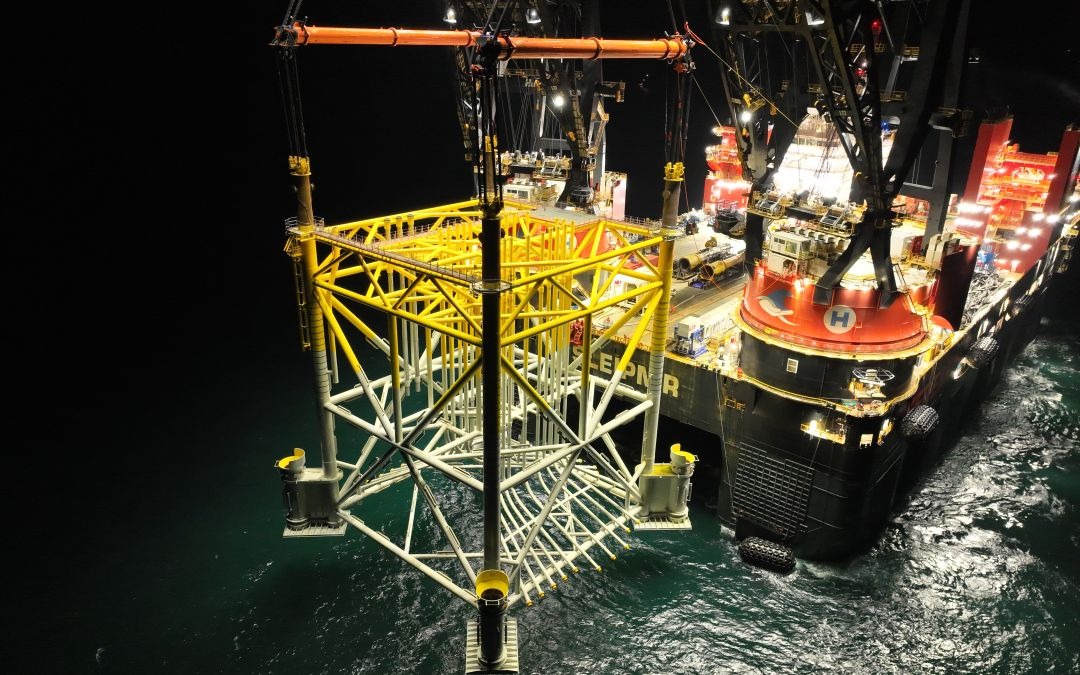
Picture: Heerema’s new modular spreader bars combine an ultra-heavy lifting capacity of about 9000 tonnes per spreader bar with the flexibility to be reconfigured for multiple projects (photo Heerema Marine Contractors, cover picture SWZ|Maritime November 2026).
Also read: SWZ|Maritime’s July-August 2026 issue: Three roads to the same destination