82 per cent of maritime professionals surveyed say current training does not adequately prepare seafarers for the realities of modern, digitally-enabled vessel operations. Just eighteen per cent believe training keeps pace, according to new research from OneOcean and Thetius.
Seafarer training is falling behind rapidly evolving operational realities at sea, according to two new reports commissioned by OneOcean and conducted by maritime innovation consultancy Thetius.
The research draws on survey data and interviews with maritime professionals across shipboard and shore-based roles. Those interviewed and surveyed include masters, officers, engineers, superintendents, training personnel, crewing staff, and shore-based operators.
Interconnected challenges
Findings reveal two interconnected challenges – that seafarers work in increasingly complex digital environments, and that maritime professionals do not feel well prepared to keep pace with this change. The reports suggest that whilst the global seafaring workforce may be qualified on paper, it is under prepared in practice.
According to the first report, Competent or Compliant?, the research found that:
- 82 per cent of respondents say current training models do not prepare crews for modern operations.
- 52 per cent report that qualified crew struggle in real operations ‘often’ or ‘very often’.
- 56 per cent say ‘tick box’ compliance contributes to this gap.
- Eighteen per cent believe current training adequately prepares crews for operational reality.
The maritime professionals that responded say these competence ‘gaps’ are most visible during:
- Abnormal or unexpected situations (67 per cent).
- High-pressure operations (56 per cent).
- Working between different vessels (36 per cent).
- When using complex digital systems, ECDIS or reporting tools (31 per cent).
The link between systems and alert fatigue
According to the second report, Decision-optimised or overloaded? the digital revolution has introduced novel risks alongside new capabilities because the technology can redistribute rather than eliminate work. Modern vessels are highly connected digital ecosystems, and while this has improved reporting, transparency and efficiency, it has also had introduced challenges.
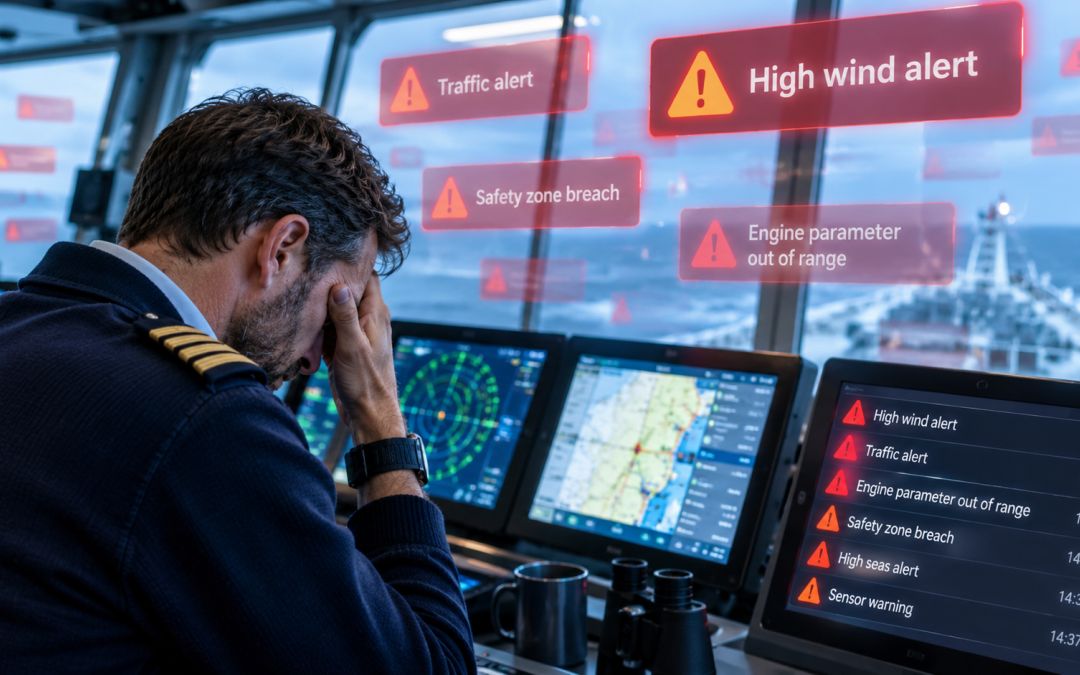
Crews increasingly act as the link between systems that do not communicate with one another, manually reconciling conflicting data across displays. The report also found that alert fatigue is a growing risk. For example, following Global Navigation Satellite System (GNSS) interference, 75 per cent of mariners reported a moderate to significant increase in workload, showing how quickly information overload can escalate when further systems alarm at once.
The report suggests that more data does not necessarily lead to better decisions, particularly in high-pressure situations, yet training courses do not sufficiently prepare seafarers to handle this reality.
Closing the reality gap
Alex Mangan, Chief Marketing and Communications Officer, OneOcean: ‘Change in shipping will only accelerate as vessels adopt new digital systems to manage tightening international regulation and to sail more efficiently and productively. This has created a growing gap between the training seafarers receive and the challenges they face at sea. The problem is twofold, coming from rapid technological changes at sea, and from the ways in which training is delivered to crews. Closing this reality gap requires the industry to shift its approaches to competence, to reflect real-world operations.’
‘The findings reveal a clear reality gap between the demands of modern shipping and the way competence is developed,’ adds Nick Chubb, Founder of Thetius. ‘As vessels become more digitally complex, the industry must move beyond compliance-based training and equip seafarers with the skills they need to operate safely and effectively.’
Picture: Alert fatigue on the bridge (image ChatGPT).