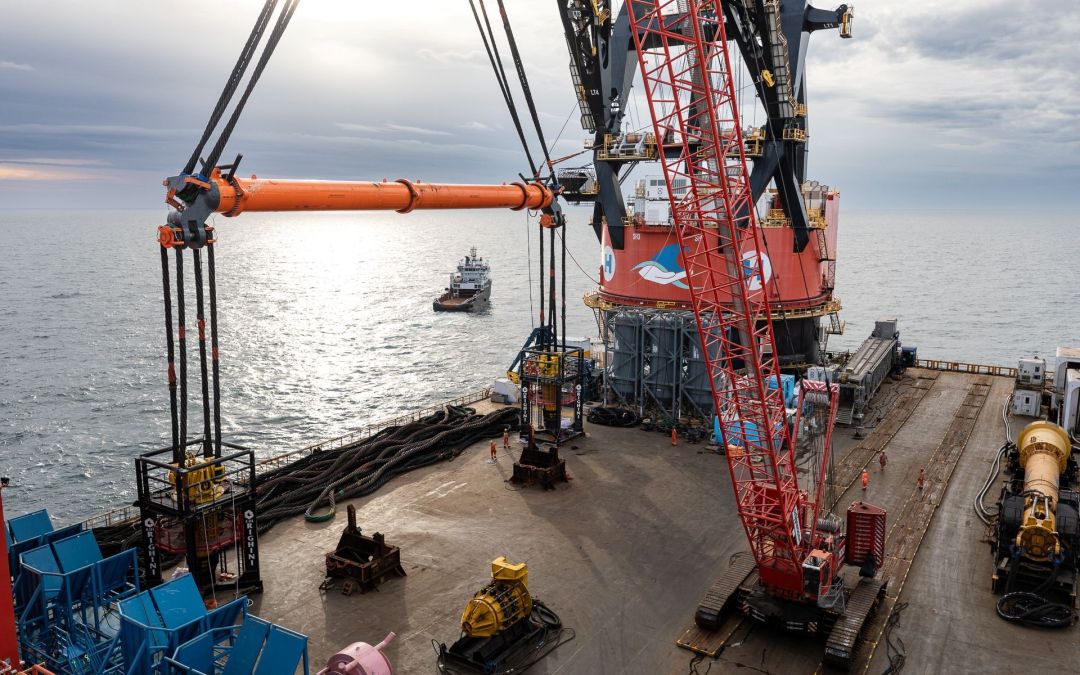
As offshore structures continue to grow in size and complexity, so do the demands placed on lifting equipment. To address this challenge, Heerema Marine Contractors has developed the world’s two largest modular spreader bars: a first-of-its-kind solution that combines an ultra-heavy lifting capacity of approximately 9000 tonnes per spreader bar with the flexibility to be reconfigured and reused across multiple projects.
Text & photography: Heerema Marine Contractors
Spreader bars are critical components in offshore lifting operations, distributing loads in rigging systems while maintaining the correct sling geometry as well as creating sling path clearance. Traditionally, offshore projects require spreader bars in different lengths and configurations because every structure has unique dimensions, lifting points, weight distributions, and sling angle requirements. Whether lifting an offshore converter station, jacket, bridge section, topside, or flare structure, equipment is often designed or modified around the requirements of a specific project.
While effective, this approach can lead to additional fabrication work, engineering effort, transportation, and steel consumption when project requirements change. In some cases, lifting equipment must be modified or returned to shore before it can be used again.
The modular spreader bar was developed to challenge this way of working. Instead of creating equipment tailored to a single application, the modular concept allows the spreader bar to be assembled from interchangeable sections. By adding, removing, or rearranging these sections, the same asset can be configured for a wide range of lifting scenarios and reused on future projects. This transforms the spreader bar from a project-specific tool into a long-term offshore asset.
Also read: Heerema to open engineering hub in Porto
Engineering modularity at extreme scale
While modular designs are common in many industries, applying the concept to a spreader bar capable of lifting approximately 9000 tonnes presented a significant engineering challenge. Every connection between the modular sections must safely transfer enormous forces while maintaining full interchangeability between components. Depending on the configuration, the spreader bar experiences different combinations of axial loads, bending moments, and shear forces, all of which must be accommodated without compromising structural integrity or operational simplicity.
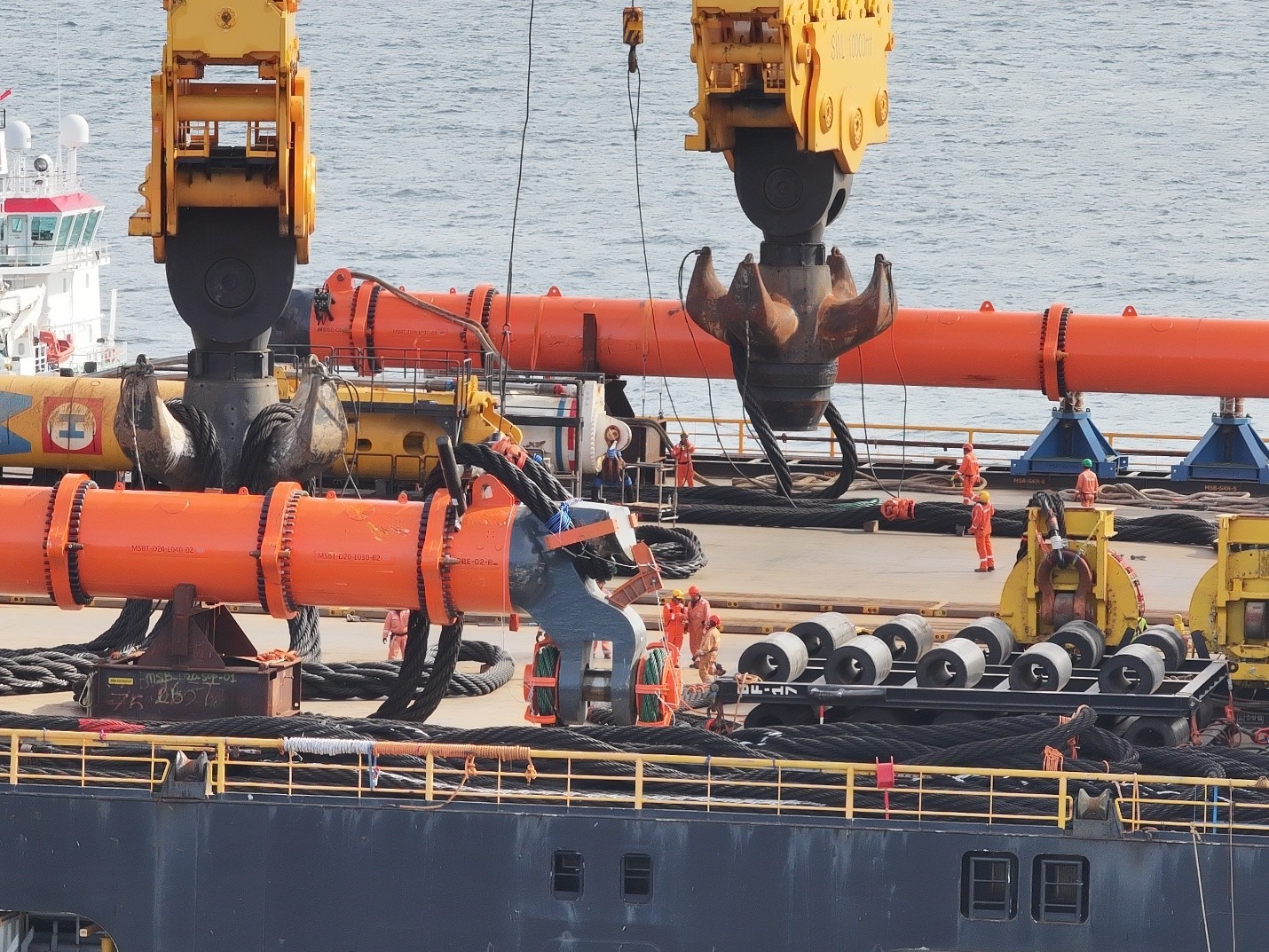
The challenge was not simply to create a strong connection. The challenge was to create a standardised connection capable of performing reliably across a wide range of configurations and load cases. To achieve this, Heerema’s engineers developed a robust modular interface that allows sections to be combined while maintaining the strength and stiffness required for offshore heavy lifting operations. The result is a lifting system that behaves as a single engineered structure while retaining the flexibility of a modular asset.
Each spreader bar is capable of handling loads of approximately 9000 tonnes. For comparison, that is roughly equivalent to lifting 6000 passenger cars with a single lifting device.
Proven offshore performance
Since entering service earlier this year, Heerema’s modular spreader bars have already been deployed across five offshore campaigns and seven lifts in total, demonstrating their reliability and adaptability in real-world operations.
Rather than remaining a conceptual innovation, the system has been tested under operational conditions across multiple projects with varying lifting requirements. This practical experience has validated the core concept: one adaptable lifting asset can support multiple campaigns while maintaining the performance and safety standards required for offshore heavy lifting.
Also read: Heerema installs 100 turbine foundations in Baltic Sea
Operational benefits beyond the lift
The advantages of the modular spreader bar extend beyond engineering. By allowing equipment to be reconfigured between projects, Heerema can reduce the need for new fabrication, minimise transportation requirements, and decrease the amount of material needed over the asset’s lifetime.
Operationally, the system provides greater flexibility when preparing for future campaigns. Instead of mobilising additional equipment or carrying out extensive modifications, the offshore crew can adapt the spreader bar configuration to suit changing project requirements. This reduces logistical complexity while helping projects respond more efficiently to changing offshore conditions.
Also read: Heerema lands three decom projects in UK North Sea
Supporting a more circular offshore industry
The project was supported by the Netherlands Enterprise Agency (RVO) and the Dutch Ministry of Economic Affairs and Climate Policy because of its potential to demonstrate circular innovation at industrial scale. By proving that even some of the largest lifting equipment in the offshore industry can be designed for reconfiguration and reuse, the project challenges the traditional assumption that heavy-lift assets must be optimised for a single purpose.
The world’s largest modular spreader bars demonstrate that engineering performance, operational flexibility, and circular design principles can reinforce one another. As offshore projects continue to increase in scale and complexity, adaptable equipment solutions such as these will play an important role in reducing material consumption, lowering emissions, and maximising the value of critical offshore assets throughout their operational lifetime.