From the magazine – In 2023, the pilot Professional Doctorate (PD) programme was launched as a post-master doctoral pathway within the universities of applied science (HBO). While traditional PhD programmes primarily focus on creating new conceptual knowledge, the PD focuses on preparing candidates through engagement in practical projects to deliver new solutions with demonstrated feasibility and applicability to real-world conditions, maintaining the same level of academic rigor.
This article originally appeared in SWZ|Maritime’s Maritime Education special (January 2026). Authors of this article are: Ieza Ramos MSc., Researcher, Maritime Technology – NHL Stenden; Diego de Leon MSc., Researcher, Maritime Technology – NHL Stenden; Dr. Lenneke Sprik, Lecturer-researcher Maritime Law – NHL Stenden; Huibert-Jan Lekkerkerk MSc. BEe AH-L0, Sr. Lecturer Ocean Technology – NHL Stenden, Sr. Consultant piLot Survey Services; and Mira de Voogd, Researcher – Rotterdam University of Applied Sciences.
Guided by the motto “Learning to make interventions in complex business practices”, the PD is a practice-oriented path that develops new knowledge and processes in response to industry needs, focusing on bridging the gap between research, practice and society. Since its launch, candidates have joined the maritime domain national pilot programme under supervision of the Dutch universities of applied science NHL Stenden, Hogeschool Rotterdam and Hogeschool van Amsterdam.
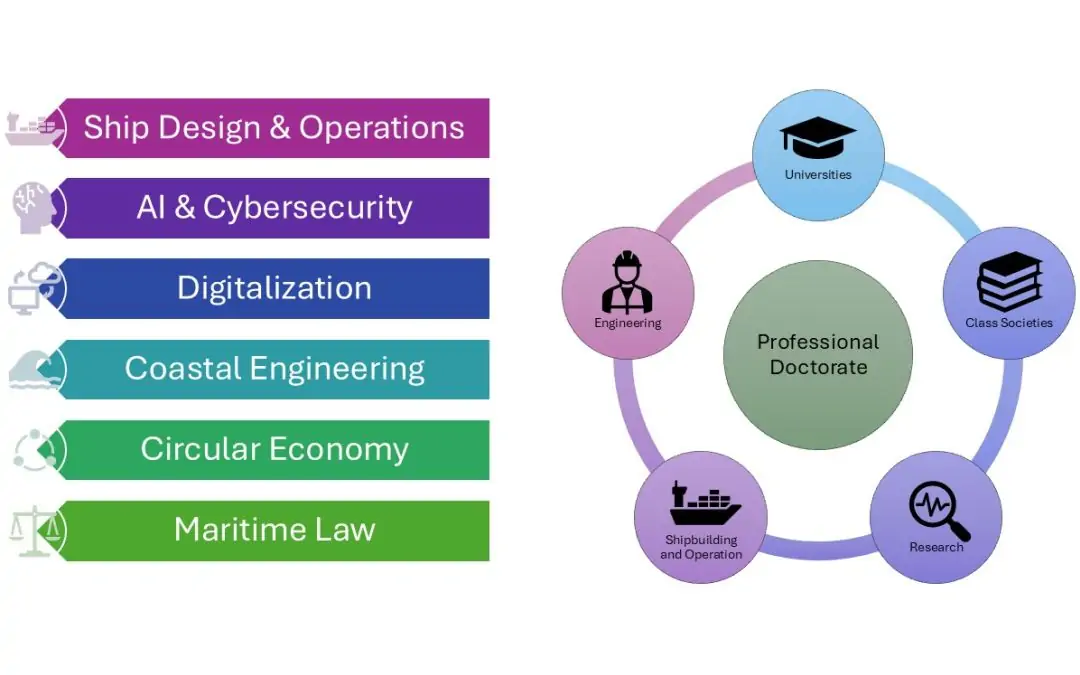
Currently, five candidates are pursuing research topics in the maritime domain, spanning digitalisation, ship design and operation, cutting-edge technologies and artificial intelligence, circular economy in shipping, coast structure verification, cybersecurity and legal aspects of maritime data. The PD pathways are closely integrated with industry stakeholders to strengthen innovation and collaboration across the sector.
Partner organisations include important European players across multiple sectors: shipbuilding, the Royal Netherlands Navy, engineering and technology, class societies, research institutions, and universities. This international, multi-sector collaboration extends the programme’s impact beyond Dutch waters, providing global benchmarks and fostering a competitive edge in the maritime domain.
Also read: TODDIS paves way for data-driven shipping and ship design
SAFE-ACT
Sensor-enhanced Assessment for Flooding and Emergency & Actionable Countermeasure Tools – Ieza Ramos MSc.
SAFE-ACT looks into key aspects of ship emergency: rapid damage assessment and effective emergency response during flooding scenarios. When a ship is damaged, early identification and timely countermeasures are essential to protect both vessel and its crew. In practice, however, getting a clear picture is not an easy task. The extent and location of damage are often uncertain, onboard sensors don’t always provide complete information and crews must operate under high stress and pressure. These factors can delay critical decisions and reduce overall situational awareness.
To address these challenges, SAFE-ACT proposes an integrated approach combining a sensor network, crew observation and artificial intelligence to assess damage and predict flooding progression. Central to the work is the development of a decision support system (DSS). The system should
be able to, in real time, continuously monitor the ship’s condition, detect damage, forecast flooding evolution and support the crew by recommending suitable countermeasures.
Artificial intelligence plays a key role by analysing motions and water-level sensor data to identify anomalies and estimate damage severity. Beyond operational response, SAFE-ACT also looks at how future ships can be better equipped, with an analysis of sensor placement optimisation, aiming to define practical recommendations for adequate design.
SAFE-ACT is developed within the D-SIDE project, a collaboration between the Dutch Ministry of Defence, industry partners Damen Naval, MARIN and TNO, and the universities NHL Stenden, TU Delft and TU Eindhoven. By connecting shipbuilding, operations, research and academic contribution, SAFE-ACT has the potential to provide a system meeting real-world and practice requirements, contributing to overall maritime safety.
D3: SEA
Data Driven Design: Ship Engineering Application – MSc. Diego de Leon
The D3: SEA prototype explores how data-driven technologies can enhance the early phases of ship design, amplifying designers’ capabilities to navigate the paradigm shift driven by new propulsion systems and energy sources. This initiative is part of the EU Horizon SEUS Project, which aims to digitise the European shipbuilding industry by developing a Smart Shipbuilding Framework, an integrated platform combining CAE, CAD, CAM, and PDM software and validating it through real-world testing at shipyards. The project unites academic expertise (NTNU, NHL Stenden, University of Turku), software specialists (SARC BV, Cadmatic, Contact Software), and shipbuilding leaders (Gondan Shipbuilders, Ulstein).
A natural starting point for this challenge was the ship’s general arrangement (GA), a design phase traditionally reliant on heuristic knowledge and experience, which makes it poorly suited for optimisation via conventional computer-aided engineering (CAE) tools. Despite its critical role in concept development, the GA process remains labour-intensive, dominated by repetitive spatial planning tasks that slow down iteration. To address this, the prototype adopts a generative adversarial network (GAN), an architecture chosen for its adaptability and seamless integration with existing engineering workflows.
The tool builds on industry-tested models that encode the distribution of volumes and sub-partitions within a vessel, paired with an embedded CAD core to generate plausible subdivision proposals aligned with designer inputs. By automating low-level spatial reasoning while preserving designer oversight, the system accelerates the GA phase without sacrificing the expertise-driven judgment that defines high-quality ship design. The PD structure has been instrumental in shaping the prototype, allowing a critical balance between industrial requirements and research innovation. This dual focus ensures the tool not only addresses the practical needs of shipbuilders, but also lays the basis for the integration into the EU Horizon SEUS platform.
Also read: A new era of digital ship design?
Legal and ethical guidelines for AI and data use
Dr. Lenneke Sprik
With the use of artificial intelligence (AI) gaining more ground in the maritime field, uncertainties regarding the legal and ethical consequences this may have for shipyards, shipbuilders, shipping companies and ports have increased. There is a strong willingness to use AI, because it contributes to more efficient operations, but the companies involved need more clarity on how to use AI and share data in a way that is ethically and legally sustainable.
It is currently not clear how new laws such as the EU AI Act and EU Data Act would apply to ships using AI systems. If systems are considered “high-risk” based on the AI Act, this could significantly influence the requirements these systems need to fulfil. The EU Data Act, effective since 12 September 2025, imposes the obligation on original equipment manufacturers (OEMs) to share data with users of connected products and services. What does this mean for the shipping companies and OEMs, for instance when this includes sharing data from which system designs or algorithms can be derived? Or how to comply with the General Data Protection Regulation (GDPR) if this includes data about crew members, passengers or operators? Data security is also important as the number of data flows in the maritime sector increases.
For the purpose of developing sufficient support for the use of AI systems (at all levels of companies involved), it is furthermore relevant to take norms and values into account in designing AI systems. Trust in AI systems is crucial for both crew and society to support their implementation.
Also, if big companies have control of data generated by the systems used, what power do they have? This concern makes data governance important. The absence of a clear ethical framework results in a risk of distrust of AI systems. As such, good governance of data is important to develop ethically responsible systems by taking into account values like transparency, accountability and trust.
This PD project addresses these challenges by looking into practical, legal and ethical aspects for AI and data usage in shipping. It is part of the Maritime AI Innovation Lab, which includes MARIN, Damen Shipyards, RH Marine, Safe Systems, TU Delft and NHL Stenden as main consortium partners. The outcome of this research will be an integrated framework of legal, ethical, and normative tools that support the safe and sustainable adoption of AI and data sharing in the maritime field.
Design and verification of coastal protection works
Huibert-Jan Lekkerkerk MSc BEe AH-L0
The Netherlands is heavily involved in building coastal protection constructions not only in the Netherlands, but also worldwide. A recurring issue in these projects is the (perceived) gap between the verification of the construction and the specification of the construction (design). This involves different disciplines, notably civil engineering for the design and construction while the verification is often, if not always, at least partially based on (hydrographic) surveys. This PD research investigates the gap along three different research lines. The first are more technical questions related to the possibilities of research with a strong focus on the verification of rock work constructions.
In this area, systematic research has been lacking with much research related to project work. The second research line focuses on how the verification is specified and how this relates to the design specifications and construction tolerances. This research will focus on existing literature, but also research international contracts to investigate how verification is specified with respect to the state of the art.
The final question is a human factor question. Not withstanding some lacking technical research, much is known about both the construction, but also the verification/survey of these constructions.
What needs to be realised is that coastal projects can take years to design, tender and construct with different persons being involved at different stages. The question is how does this process work and what can be done to minimise the perceived gap, so that discussions during the construction and verification phase are minimised. This research line will investigate how information is transferred, if all required information is available at the correct stage of the project, and if choices (as found during the contract research) are intentional.
Also read: SWZ|Maritime’s January 2026 issue: Know how
Circularity in vessel refit
Mira de Voogd
The maritime industry faces a substantial sustainability challenge. New regulations, increasing concerns about the availability of raw materials, and growing global pressure to reduce environmental impacts are compelling companies to lower emissions and waste across the entire vessel lifecycle. Circular economy principles, such as reuse, repair, refurbishment, and remanufacturing, offer a promising pathway by keeping materials in use for longer, reducing the demand for primary raw resources, and improving overall value retention.
Despite this potential, circularity is not yet widely adopted. The sector lacks unified and standardised evaluation frameworks, collaboration across the vessel value chain remains fragmented, and current approaches still focus predominantly on end-of-life recycling rather than on informed design and refit decisions made earlier in the lifecycle. This PD project aims to address these barriers and accelerate the adoption of circular practices within the Dutch maritime industry.
Central to the project is the development of a maritime-specific assessment tool for measuring circularity performance. The tool enables suppliers, shipyards, and classification societies to monitor progress, identify improvement opportunities, comply with emerging regulatory requirements, and strengthen supply chain resilience.
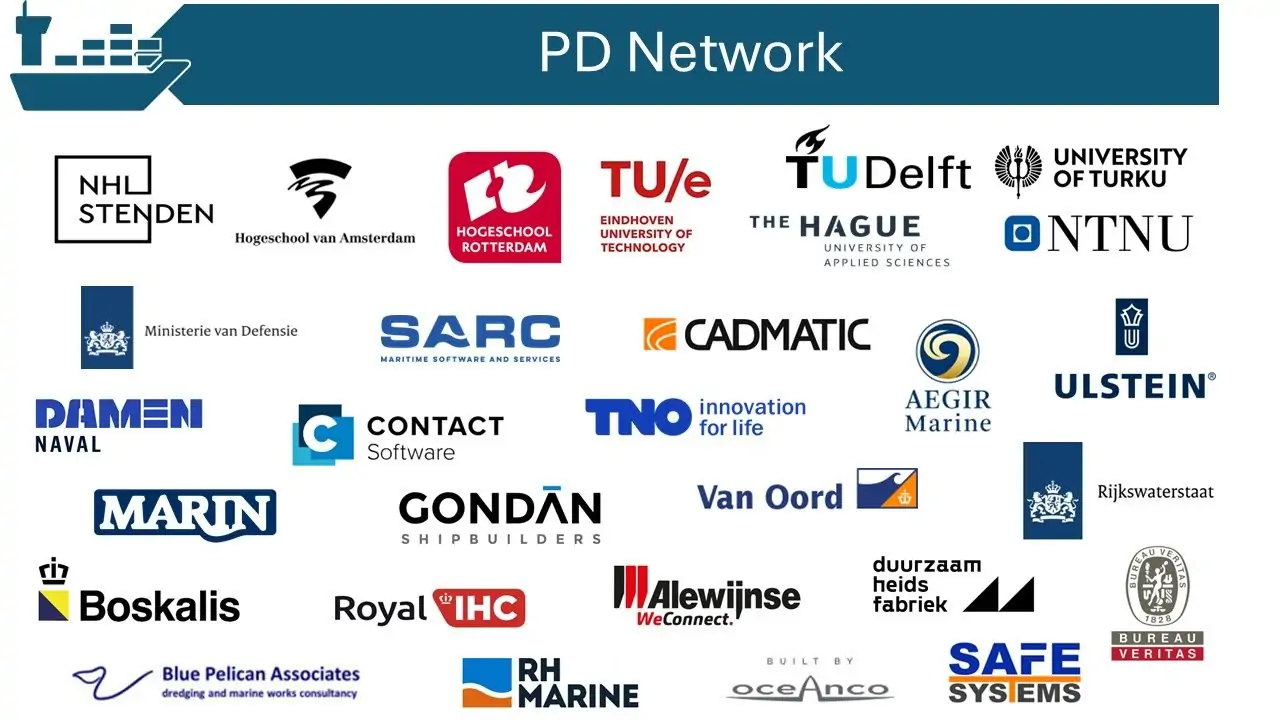
The project is supported by Circolab Maritiem, an open joint initiative led by TU Delft, The Hague University of Applied Sciences, and Rotterdam University of Applied Sciences, in collaboration with Duurzaamheidsfabriek, Royal IHC, TNO, Maritime & Offshore NL, AEGIR-Marine, Damen Shipyards, Bureau Veritas, Oceanco, and Alewijnse. Next steps include the iterative development, testing, and scientific validation of the assessment tool, alongside pilot studies with industry partners to ensure practical relevance and broad adoption.
Picture (top): The PD research topics span digitalisation, ship design and operation, cutting-edge technologies and artificial intelligence, circular economy in shipping, coast structure verification, cybersecurity and legal aspects of maritime data.