The maritime sector has played an important role in Polish history, from the medieval Hanseatic city of Gdansk to the shipyard strikes that helped bring an end to socialism in the 1980s. That role continues to this day, with yacht building playing a particularly notable part.
This article was written by Thomas Walta, Maritime Technology student at the TU Delft. For SWZ|Maritime, he took part in a tour of Poland’s yacht building industry.
Poland is Europe’s largest producer of motorboats up to 12 metres in length and the world’s second-largest after the US. Some 95 per cent are exported. Polish companies now want to move beyond smaller vessels and build larger yachts to compete with established Dutch names. Most Polish yacht builders are currently working on the largest vessels they have ever built. With the support of the Polish Investment & Trade Agency, SWZ|Maritime gained an insight into Poland’s growing yacht building sector.
Also read: Damen Yachting sells another Xplorer 60
Conrad Shipyard: From sections to yachts
In the port of Gdansk lies a site where vessels have been built for decades. It is the birthplace of the Soldek, the first Polish ship built after the Second World War. Conrad Shipyard was pioneering at the time thanks to the welding techniques used here.
Today, the yard produces sections for Meyer Werft in Germany. Since 2003, a small part of the shipyard has also focused on a different type of vessel: yachts. It started with a 27-metre motor yacht, but there was soon a desire to build increasingly larger yachts. Specialisation is difficult here, as the yard builds both custom vessels and series-produced yachts.
This is also reflected in the shipyard’s latest project, which targets a niche in which it has no previous experience: sailing yachts. Conrad Shipyard is currently building the 41-metre C-140 superyacht. According to the director, it will be a high-performance sailing yacht, although that is difficult to imagine when looking at the vessel.
A considerable amount of space has been dedicated to luxury. The owner’s cabin, for example, has two bathrooms, while ample room has also been allocated to a 19,000-litre fuel tank. This gives the yacht a range of 6500 nautical miles without refuelling. Whether the vessel will actually spend much time under sail, however, remains to be seen.
Cumbersome way of working
The shipyard clearly shows how quickly Conrad has grown. Every available space is being used, and the expansion means the car parks are now located in less-than-ideal places. This lack of space creates several challenges. For example, the interior outfitting takes place on the first floor. The cabins are also mock-ups here for the owner’s approval. Once everything meets their requirements, the mock-ups have to be completely dismantled. The individual components can then be taken downstairs by lift and installed on board.
It is a cumbersome way of working that seems difficult to sustain for the 100-metre vessels the yard plans to build. The company is already considering various creative solutions, such as working with pontoons, while plans are also being developed for new sheds.
That creativity is characteristic of Conrad. For example, a recent design did not have enough space for the crew. The managing director simply drew a more square-shaped hull with a marker, and this resulted in the vessel type now being built. Without proper hydrodynamic analyses, this would naturally come at the expense of performance, but that does not seem to be a major concern for the vessels built here. They are fairly standard, after all. Little use is made of innovations, for example in the field of sustainability. The pioneering spirit that characterised the construction of the Soldec here 75 years ago has largely disappeared.
Also read: Oceanco acquires maritime equipment company Winel

Producing sails
The Gdansk shipyard also provided the foundation for another company, Sail Service. It was established seventy years ago as a state-owned company that was part of Conrad. It produced sails for pleasure craft in the Eastern Bloc. After the fall of communism, it became a private company and was acquired by a group of students. This also changed its target market. Sail Service began exporting to European countries and started producing sails for tall ships. Today, the company has a 700-m2 production facility where it produces 30,000 m2 of sail each year.
Little has changed in sailmaking itself over the past seventy years. It is still largely done by hand, with the production hall effectively serving as one large sewing table. There are various openings in the floor containing sewing machines, with the operators working behind them. The process is still clearly manual: two people are needed to guide a large sail through the sewing machine. The largest sails, measuring 300 m2, can easily weigh 160 kg. Once a tall ship sail is finished, it typically lasts around five to ten years. After five years, the Dacron starts to stretch, gradually causing the sail to lose its shape. Because sailmaking is such a specialised craft, the company also produces many of its own tools.
Membrane Cell sails
There have nevertheless been innovations in sailmaking. Sail Service now also works with Membrane Cell sails from an Italian supplier. These are not woven but consist of fibres that are bonded together, making the sails considerably lighter and stronger. As the maritime sector works to become more sustainable, sails are also increasingly being considered as a way to reduce emissions. One example is the use of kites on cargo ships. Sail Service would like to develop products for this market, but so far it has been unable to gain a foothold in it.
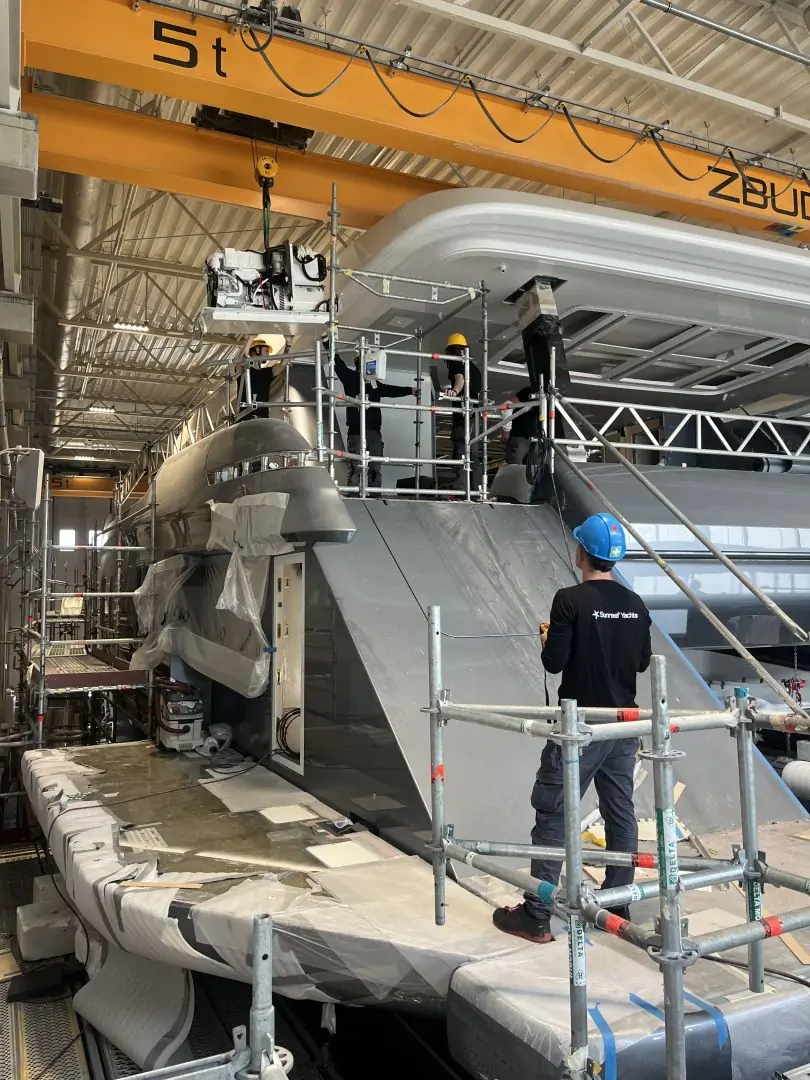
Luxury catamarans
Yet, Poland has also developed a niche within yacht building: luxury catamarans. Sunreef Yachts Shipyard was established for this purpose by a French businessman. In his view, a catamaran provides a better basis for a luxury yacht than the traditional monohull. A wider hull combined with a shorter length quickly creates more space on board. The shallower draught also allows larger yachts to reach more destinations. Finally, the vessel is more stable, making it more comfortable on board.
Despite these advantages, the concept was not an immediate success in the yacht industry. When the first boat, built in 2003, was presented at the Monaco Yacht Show, there was little interest. According to Sunreef, this was due to two prejudices the company had to overcome: catamarans and “made in Poland”.
Solar panels and sustainable options
Yet, the company quickly established itself in the yachting industry, among other things with the Eco versions of its various catamaran models. These are packed with sustainable innovations developed by Sunreef’s R&D department. Particularly impressive are the solar panels produced here. Just one millimetre thick, they are integrated into the composite structure of the hull.
The interiors also make extensive use of recycled materials, while the catamarans can be fitted with electric or hybrid propulsion. The company also experiments with new concepts, such as kites for additional propulsion. This proved unsuitable for a luxury yacht, however, and only one vessel was built with the system. These technologies remain optional extras, and Sunreef is not yet prepared to make the sustainable alternatives standard across its range. Nevertheless, half of all catamarans now sold have electric or hybrid propulsion.
Branching out to the United Arab Emirates
Since its founding in 2003, Sunreef has continued to grow. The company now has two production facilities in Gdansk, employing 1900 people. This allows up to thirty catamarans to be under construction at the same time. The company recently expanded to another continent, opening a shipyard in the United Arab Emirates in 2024 to gain better access to eastern markets. The facility builds a different type of catamaran. The market there is somewhat more conservative and favours catamarans that resemble traditional yachts more closely. They are therefore narrower and capable of higher speeds.
Setting up a shipyard in a country with little experience in yacht building was not straightforward. Workers had to undergo extensive training from members of the Polish team. Now that the first vessels are being built there, Sunreef continues to work towards increasing production volumes.
Yachts for the US
Another Polish shipyard looking to build increasingly large yachts and compete with the Dutch yacht-building industry is Galeon Shipyard. The company has been building its own yachts since the 1990s. Its range covers a broad selection of designs, from just under 10 metres to around 25 metres in length. All of them are produced in series. The designs are not particularly distinctive.
Half of the vessels are sold in the United States, a market that Galeon conquered quickly and which has driven significant growth. The designs are therefore tailored to the general preferences of this market. The yachts have plenty of power, are capable of high speeds and make little use of sustainable innovations. They feature conventional propulsion systems and are often delivered with teak decks.
Composites and in-house production
What does make this shipyard distinctive is its innovation in production. Considerable research is carried out into the composites used to build the hulls. In addition, its modern machinery allows the yard to produce moulds up to 25 metres long.
Many components are manufactured at the shipyard itself. This includes not only the hull, but also all the furniture and even the mattresses.
Also read: KNVTS organises nuclear propulsion lecture at METSTRADE
Explorer
Among Galeon’s series-produced models, one unique vessel stands out: the Explorer. Designed as a family boat for slower cruising on lakes, it is not a true explorer capable of breaking through ice, reaching remote destinations or covering long distances. The square-shaped design features fold-out sections on the sides of the deck, creating additional space for bar stools.
A year after its presentation, the first Explorer has still not been sold. The design was probably an attempt to enter a new market. The US market has become increasingly unstable due to geopolitical tensions, posing a risk to Galeon since fifty per cent of its vessels are sold there. Another way the shipyard is trying to reduce this risk is by moving into larger yachts, which are likely to have a more stable market.
Polboat
Polish yacht builders come together at the annual Polboat festival, organised by the industry association of the same name. Alongside the larger 25-metre yachts, the event also features many manufacturers of smaller motorboats. One example is Canna, which started out building sustainable electric vessels. However, it now also produces boats powered by fossil fuels, as demand for them remains high.
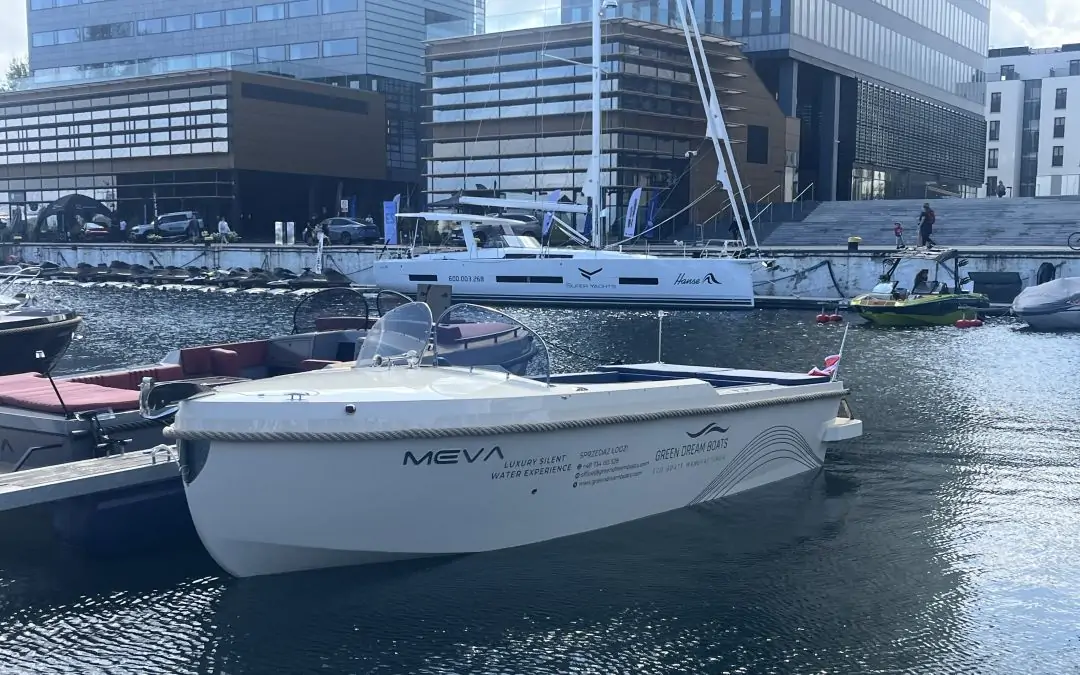
Dutch can occasionally be heard at Polboat. Several components for Polish yachts are supplied by Dutch companies. One example is the propulsion systems provided by RIM Drive Technology from Andelst. Its propellers are ideally suited to the electric propulsion systems used in many sustainable boats. This demonstrates that Dutch companies also play an important role in delivering innovation to Poland’s yacht-building industry.
Technical innovation lags behind
Polish yacht building has shown that the country is highly capable of producing large numbers of vessels. Its production facilities are often modern and highly optimised, as demonstrated by companies such as Sunreef and Galeon. However, the innovations found in production techniques are less evident in the yachts themselves. Most builders describe their yachts as innovative, but when asked to explain why, they often point to the luxurious interiors, large sun decks or spacious accommodation as key innovations. Technical aspects such as propulsion, sustainability and hull design rarely feature, suggesting that these receive relatively little attention during the design process.
This is probably linked to the strong market focus of the Polish sector. Many companies are reluctant to specialise and instead adapt their strategies according to what sells. Sunreef, for example, is building a shipyard in the Middle East for faster catamarans, while Canna Boats has moved beyond purely electric propulsion and now also offers boats powered by fossil fuels.
The market is also driving many Polish yacht builders towards larger vessels. This appears to be the direction in which the country’s yacht-building sector is heading. There is, however, a note of caution: these companies are likely to remain strongly guided by market demand.
Picture (top): Most Polish yacht builders describe their yachts as innovative in terms of interiors, sun decks or accommodation, technical innovations lag behind (photo by Thomas Walta).