
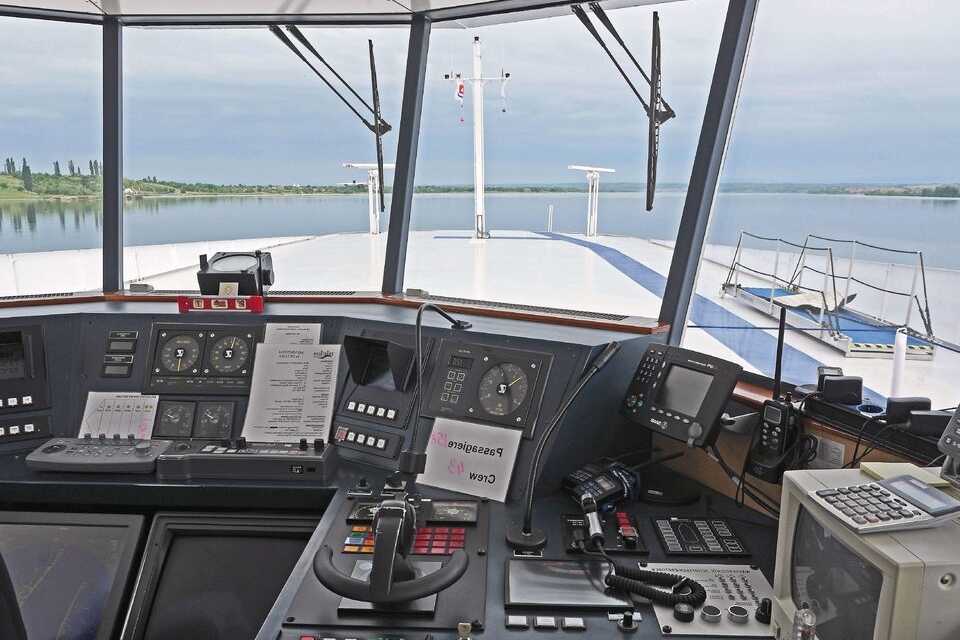
Can we improve overall safety, efficiency, and the work-life balance for the bridge watchkeeper by introducing periodically unattended navigation spaces? It is the central question of the MARIN coordinated ALERT Joint Industry Project (JIP) that officially started recently.
The kick-off took place on 9 April 2026 in Marseille, during BlueWeek, marking the formal beginning of the initiative. The project team is now actively engaging with the participating organisations to define and coordinate the work to be carried out across the different Work Packages.
This phase focuses on translating the initial ambitions of the project into concrete activities and deliverables. Work has already commenced on WP1 and WP2, which include task analysis on the navigation bridge. These first steps form an important foundation for the remainder of the project and will support further development in the subsequent work packages.
Also read: When can the bridge safely be left unattended?
Addressing fatigue
Fatigue due to irregular working and sleeping hours and monotonous (tiring) working conditions are negatively affecting watch standers in most navigation spaces across oceans and seas. Combined with often excessive working hours when the ship is in port or when the ship transits busy shipping areas, fatigue is frequently the cause of (near) accidents and incidents.
Partly because of these working conditions, well-trained seafarers choose to leave their profession, and this again requires the continuous recruitment and training of new crew members to become part of the ship’s operation. This situation causes an additional strain on the onboard operation and is a huge financial burden and an unfortunate waste of well-trained talent.
In an effort to address fatigue, the Horizon project (2012) and Martha Project (2013-2016) focused on changing the watch schedules without reducing the total number of hours of watch standing. New watch schedules were implemented, but did not significantly improve the conditions on board.
Also read: Fatigue claims another victory, results in vessel collision
Unattended navigation spaces
The Alert JIP takes a radically different approach, focusing on periodically unattended navigation spaces without jeopardising the safe operation. For several decades, machinery spaces have benefitted from automation systems and “unattended machinery spaces” designation, to allow machinery spaces to be unattended mostly during the “dark hours” of the day.
Automation systems monitor the technical operation to alert the engineer on duty, when necessary, to any issues needing attention. The set-up of unattended machinery spaces allowed the engineers to dedicate their working hours to the necessary maintenance during the daylight hours and maintain a more favourable and healthier daylight/nighttime sleeping pattern
The ALERT concept
The ALERT JIP will use a similar principle to allow the navigation space to be unattended for periods of time while not jeopardising safe operations. The concept:
- Defines automation: tasks to be automated to allow the system to be activated and create time for unattended navigation.
- Establishes Alert triggers: specify when crew intervention becomes necessary, considering factors such as navigational challenges, equipment status, and environmental conditions.
- Sketches the essential information display that enables watch standers to regain situational awareness to enable decision making. Considering also the time needed to regain cognition.
Also read: VIDEO: MARIN verifies ABB Dynafin propulsion performance
Project scope
In the Alert JIP, MARIN states the project team will work in close cooperation with volunteering seafarers on the following topics:
- Determine which tasks are carried out during navigation bridge watch standing at sea and establish priority indication for each identified task.
- Define, with input from the consulted crew members, what constitutes safe conditions/situations and establish safety level benchmarks for external conditions (weather, sea state, traffic density, proximity to navigational hazards and land) and vessel-specific factors (cargo configuration, maneuverability, vessel size, operating speed).
- Assess the impact of safe conditions on watch standing hour reduction across different operations. For example by utilising route simulation methods to quantify operational impacts.
- Create an alerting scheme to notify the watch stander that the safe situation or conditions have changed from the pre-set levels using human machine interface (HMI). Including determining how to build situational awareness.
- Analyse technological requirements and conduct gap analysis against commercially available solutions.
- Validate alert schemes and HMI systems using simulator facilities and collect feedback from designated crew members onboard operational vessels.
- Document the potential impact on (IMO) regulations and assess implications for safety, security, and environmental processes on board.
Also read: MARIN launches app for roll-period measurements
Towards a proof of concept and trial
At the end of the project, the researches hope to have a proof of concept that shows how this improves overall safety, efficiency, and the work-life balance for the bridge watchkeeper. They also hope to win approval for a trial. Finally, they hope to deliver a draft-amendment to IMO regulations, specifically to STCW Regulation VIII/2, in order to extend the trial period to permanent, and to extend the conditions for safe unattended navigation spaces.
Partners in the project are ClassSK, ABB, Boskalis, NHL Stenden, Lloyd’s Register, Seaspan and Commit. Shipping companies, maritime organisations and technology developers are still welcome to join. The JIP will run for three years.