

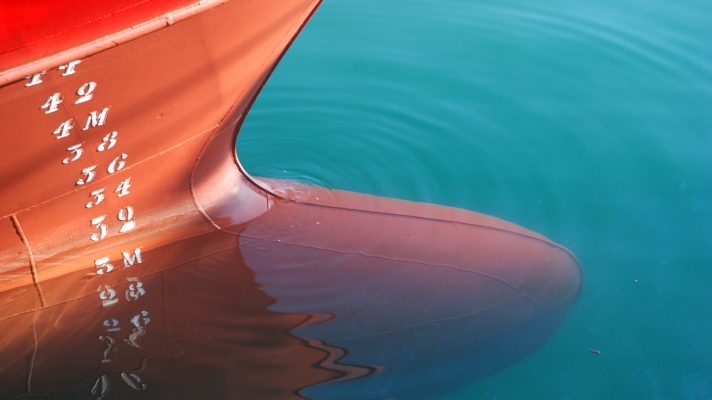
Poor ergonomics, trying to do too much at once and a high speed contributed to a ferry grounding in darkness. The Nautical Institute describes the incident in a new Mars Report.
The Nautical Institute gathers reports of maritime accidents and near-misses. It then publishes these so-called Mars (Mariners’ Alerting and Reporting Scheme) Reports (anonymously) to prevent other accidents from happening. This is one of these reports.
In the early morning, a crew of three were bringing a small ferry to its departure port for the first run of the day. Having just left the sleep-over port in darkness, the captain found that the displays of the two engine monitoring instruments were shining too brightly, hampering his night vision.
The displays were located to the left of the driver’s seat, but access to them was constrained by the left armrest of the chair. Once out in the fairway, the captain activated the autopilot that was integrated into the left armrest. He then raised the armrest and attended to the displays.
To dim the light on the displays, two buttons had to be pressed simultaneously. The buttons were not backlit, so the captain took out his mobile phone and activated the flashlight function to see better. With the phone in one hand, he pressed two buttons simultaneously with the other hand. On his first attempt, the display went completely black instead of dimming.
Concentrating on this task for a second time, he saw something appear in front of the ship. With no time to turn away the ferry ran aground on an island at a speed of almost 16 knots.
Also read: Fatigue leads to passenger vessel grounding
Investigation findings
The investigation found, among other things, that the autopilot’s “change in operating mode” warning was not effective. The autopilot probably became disengaged when the armrest was raised to give the captain access to the engine monitoring displays, without him being aware of this.
At nearly 16 knots, it only took a few seconds for the ferry to veer off course and run into danger while the captain was preoccupied with dimming the panels.
Also read: One grounding not enough to warrant attention
Advice from The Nautical Institute
- Poor design and ergonomics are nefarious unsafe conditions that often go unnoticed until it is too late.
- In darkness and navigating the vessel in a restricted waterway, the captain was trying to undertake an adjacent task that takes both hands and both eyes.
- Once again speed is an issue. At 16 knots, the captain did not put chance on his side when deciding to attend to an adjacent task.
- A seaman was sitting in the aft part of the wheelhouse without duties. He would have been more useful as lookout.
Also read: Poor BRM between pilot and bridge team leads to grounding
Mars Reports
This accident was covered in the Mars Reports, originally published as Mars 202537. A selection of the Mars Reports are also published in the SWZ|Maritime magazine. The Nautical Institute compiles these reports to help prevent maritime accidents. That is why they are also published (in full) on SWZ|Maritime’s website.
More reports are needed to keep the scheme interesting and informative. All reports are read only by the Mars coordinator and are treated in the strictest confidence. To submit a report, please use the Mars report form.