

‘Don’t let your “can do” attitude lead you into a dangerous position,’ warns The Nautical Institute in its latest Mars Report. In this report, a crew member’s leg got caught in a telescopic accommodation ladder while trying to quickly solve a problem.
The Nautical Institute gathers reports of maritime accidents and near-misses. It then publishes these so-called Mars Reports (anonymously) to prevent other accidents from happening. A summary of this incident:
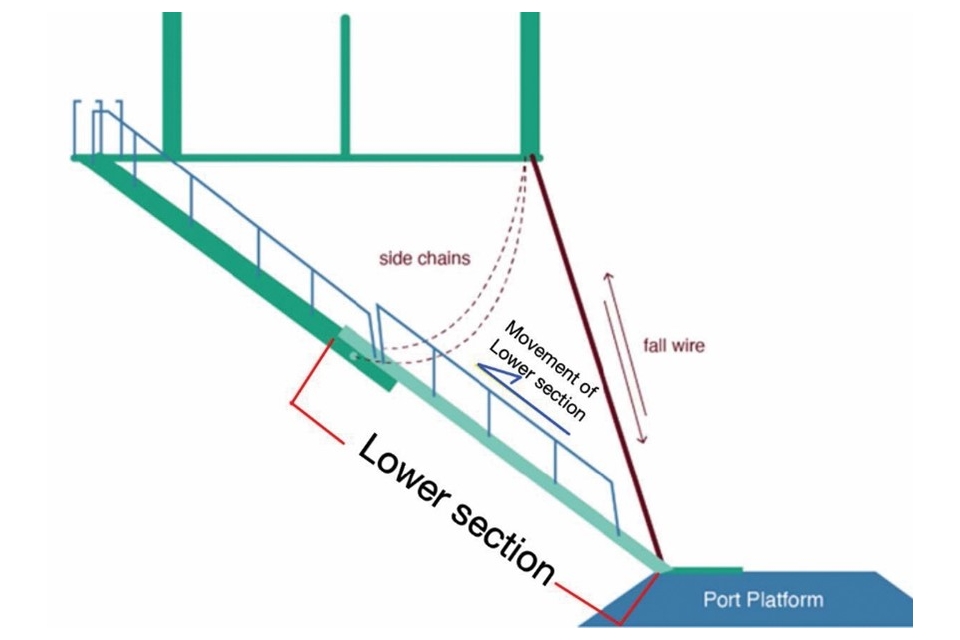
A vessel was about to leave port. Once the pilot had boarded, crew began to secure the accommodation ladder for sea passage. This ladder was of “telescopic” design, such that the lower half was able to slide inside the upper half for securing. Although of a class approved design and SOLAS compliant, the practical considerations of using this particular type of ladder were complicated.
A previous incident had led to a risk assessment that identified the entire upper section as a “dangerous area” while the ladder was being retracted. As a result of this risk assessment, the company had established a procedure that no person should stand in that area during securing operations. However, it appears this was routinely violated, as in this instance.
Also read: Accommodation ladder pin failure accident shows need for maintenance guidelines
The inboard handrail side chain became caught between the sliding lower ladder and the fixed upper ladder, and a crew member stepped onto the upper ladder to free it. Once he had cleared the inboard handrail chain, he picked up the outboard handrail chain and held onto both to prevent them from getting caught again. Holding both chains, he stood on a step close to the top of the fixed ladder, but within the area identified as dangerous from the previous incident.
On board, another crew member resumed heaving on the fall wire to retract the lower section of accommodation ladder. As this was proceeding, the ladder end dropped off the port platform. Because the side chains were slack and not supporting the fixed upper ladder, the weight was transferred from the dock platform and onto the fall wire. This resulted in an unexpected and uncontrolled upward movement of the lower ladder.
The sudden upward movement of the lower ladder trapped the victim’s left leg between the top step of the lower ladder and the third step of the fixed upper ladder. All work stopped immediately, and the crew wedged timber between the steps to ease the weight on the victim’s leg and prevent further injury.
It was decided that the safest option to free the victim’s leg was to cut the step. This was accomplished, and at the same time the first responders boarded the vessel and brought the victim to hospital.
Also read: ‘Accommodation ladder handrail installation should be handled with care’
Advice from The Nautical Institute
- Each close call, incident or accident is an opportunity to improve safety by analysing the events and implementing mitigating measures such as new procedures or engineering solutions. To be fully effective, the new procedures should be followed.
- Don’t let your “can do” attitude lead you into a dangerous position, as with the victim in this accident. Follow the established procedure.
Also read: Accommodation ladder failures are rare, but pose a real risk
Mars Reports
This accident was covered in the Mars Reports, originally published as Mars 202340, that are part of Report Number 371. A selection of the Mars Reports are also published in the SWZ|Maritime magazine. The Nautical Institute compiles these reports to help prevent maritime accidents. That is why they are also published (in full) on SWZ|Maritime’s website.
More reports are needed to keep the scheme interesting and informative. All reports are read only by the Mars coordinator and are treated in the strictest confidence. To submit a report, please use the Mars report form.