
Econowind is celebrating its tenth anniversary, with more than 170 VentoFoil units sold to shipping companies around the world. Reaching the ten-year mark highlights both the company’s journey from early start-up to established scale-up, and a broader shift in how global commercial shipping views wind power.
When founder Frank Nieuwenhuis launched Econowind in 2016 in collaboration with ship design firm Conoship International, many in the maritime sector were still sceptical about wind-assisted ship propulsion. So, he set out to show that compact, vertical wings could cut a cargo ship’s fuel use. His first tests were very hands-on: he bolted wooden prototypes to the roof of his car and used a vacuum cleaner to mimic the suction that keeps air flowing smoothly over the wing. Later, he tested an early prototype on a car trailer.
Also read: Econowind moves into deepsea market with new VentoFoils
Selling wind as a credible energy source
Early pioneers did not just have to sell a new technology, they had to sell wind itself as a credible modern energy source. When early setbacks tested Nieuwenhuis’ resolve, Gavin Allwright of the International Windship Association (IWSA) persuaded him to persevere.
Taking the concept to sea was not smooth, as early trials required manual operation by an onboard technician, and showed that smaller wings delivered limited savings on larger ships. Econowind responded by developing automated bridge controls that respond to changing winds. It also added tilting designs, so crews can lower the wings during cargo handling or heavy weather. That engineering work laid the foundation for the 3-series VentoFoil, the company’s best-selling unit.
VentoFoils ease the load on a ship’s main engine, giving operators a practical way to reduce fuel burn and compliance costs without relying on new fuel supply chains that are still taking shape. Wind propulsion also works well alongside hull and voyage optimisation as well as future low-carbon fuels.
Installations doubling every year
Over the past ten years, Econowind has grown alongside the wider wind-assisted ship propulsion (WASP) market. What began as a handful of trial installations is now a recognised commercial segment, with installations roughly doubling every twelve months.
‘In terms of the number of vessels installed, Econowind is right in the front line, definitely one of the frontrunners,’ says Gavin Allwright, Secretary General of the IWSA. ‘What has changed most over the past decade is perception: shipping now sees wind not as a romantic throwback, but as a 21st-century toolbox of commercial solutions.’
Also read: Econowind supplies VentoFoils for Amadeus Titanium
Turning emissions reduction into a financial case
Much of that growth comes down to cost and pressure to act. With fuel accounting for around half of a ship’s operating expenses, shipping companies and charterers are facing high and unpredictable fuel prices, alongside the heavy cost of long-term decarbonisation. Alternative fuels such as green methanol and ammonia remain expensive, and the production and bunkering networks they require are still being built.
Meanwhile, rules such as the EU Emissions Trading System (EU ETS) and FuelEU Maritime, which grants a reward factor for wind propulsion and allows operators to pool compliance surpluses, are turning emissions reduction into a direct financial case.
Expanding and 5-series
Entering its second decade, Econowind is focused on expanding its manufacturing capacity and rolling out the 30-metre steel 5-series VentoFoil for deepsea fleets. Ten years after testing its first scale models, the company aims to help make wind assistance a standard part of life at sea.
‘Wind propulsion is approaching an inflection point. The groundwork has been laid by technology providers such as Econowind, and the sector is now absolutely ready to ride the wave,’ Allwright adds.
Also read: Japanese Nissen Kaiun buys into Econowind
Ten years, ten stories
To mark the anniversary, Econowind is launching a series of ten stories, each told by a different voice. Together, clients, shipyards, and other maritime stakeholders tell the story of how both the company and commercial wind propulsion have developed over the decade.
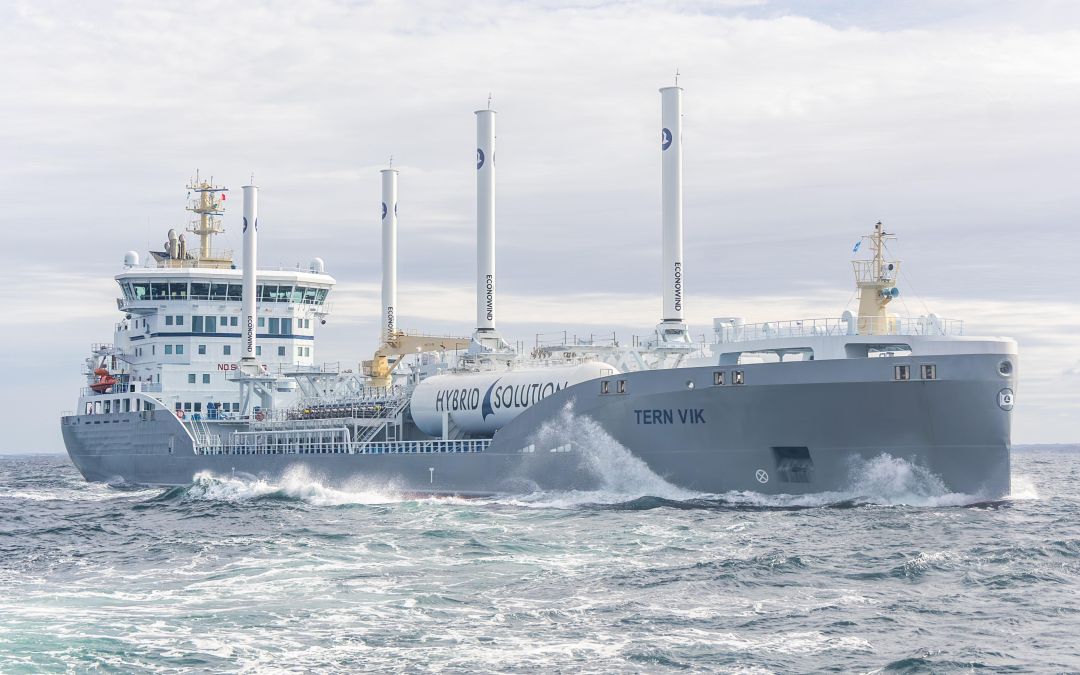
Picture: Tern Vik equipped with VentoFoils (photo Econowind).