From the magazine – The Net-Zero Framework (NZF) 2050, the International Maritime Organization’s (IMO) plan to reduce greenhouse gas emissions from shipping to zero by 2050, looks set to founder once again on opposition from the US Trump administration. Last year, at a special session of the IMO’s Marine Environment Protection Committee (MEPC), it was decided to postpone the decision by one year to allow negotiations to produce a workable compromise between the 176 member states and three associate members. However, in early November, as this preview of the meeting scheduled for 30 November to 4 December was being written, no agreement had yet been reached.
In every issue of SWZ|Maritime, SWZ|Maritime’s editor Antoon Oosting writes an opinion piece under the heading “Markets” about the maritime industry or a particular sector within it. In November 2026, he looks ahead to the upcoming IMO meeting on the Net Zero Framework. The opinions expressed in this article are those of the author and do not necessarily reflect those of the publisher (the SWZ Foundation), the KNVTS, or other editors.
This should come as little surprise to anyone who listened carefully to yet another tirade by US President Donald Trump. ‘Last year, my administration was forced to intervene to stop an obscure UN body, the International Maritime Organization, from secretly establishing a first-ever global carbon tax – a very expensive tax – that would have increased the cost of international shipping by ten to twenty per cent, and maybe more than that,’ Trump said on 22 September during the 81st session of the United Nations General Assembly in New York. ‘There is no global government — and while I am President, there will be no global taxes.’
Also read: Sector welcomes EU support, but it may be too little, too late
USD 100 to 130 per tonne of CO2
With his reference to a ‘very expensive tax’, Trump was referring to the levy-and-reward system included in the NZF. This consists of two tiers under which ships would initially have to pay USD 100 for every tonne of CO2 they emit into the NZF Fund to be established by the IMO. The most polluting ships would pay USD 380 per tonne. These rates apply for the period 2028–2030, but are due to increase substantially in 2030, 2040 and 2050.
The system is expected to generate USD 10–15 billion annually. This revenue would go towards research into and the development of fossil-free fuels, as well as supporting developing countries that are particularly vulnerable to the effects of climate change.
The purpose of this so-called pricing mechanism is to encourage shipowners to invest in cleaner vessels that use fossil-free or low-carbon fuels more frequently. The reward element allows owners of relatively clean ships to earn credits to compensate for the higher investment costs of more sustainable propulsion systems and the more expensive fuels they require, such as ethanol, methanol, hydrogen and ammonia.
Provisional agreement on draft treaty
In spring 2025, a majority of IMO member states reached a provisional agreement on a draft treaty establishing the IMO NZF. The framework would apply from 2028 to all ships above 5000 GT. These larger vessels account for 85 per cent of shipping’s CO2 emissions.
In addition to investing in cleaner ships, shipowners can also retrofit existing vessels. This means modifying them to reduce fuel consumption and CO2 emissions, or installing systems to capture emitted CO2 for reuse or storage in depleted oil and gas fields.
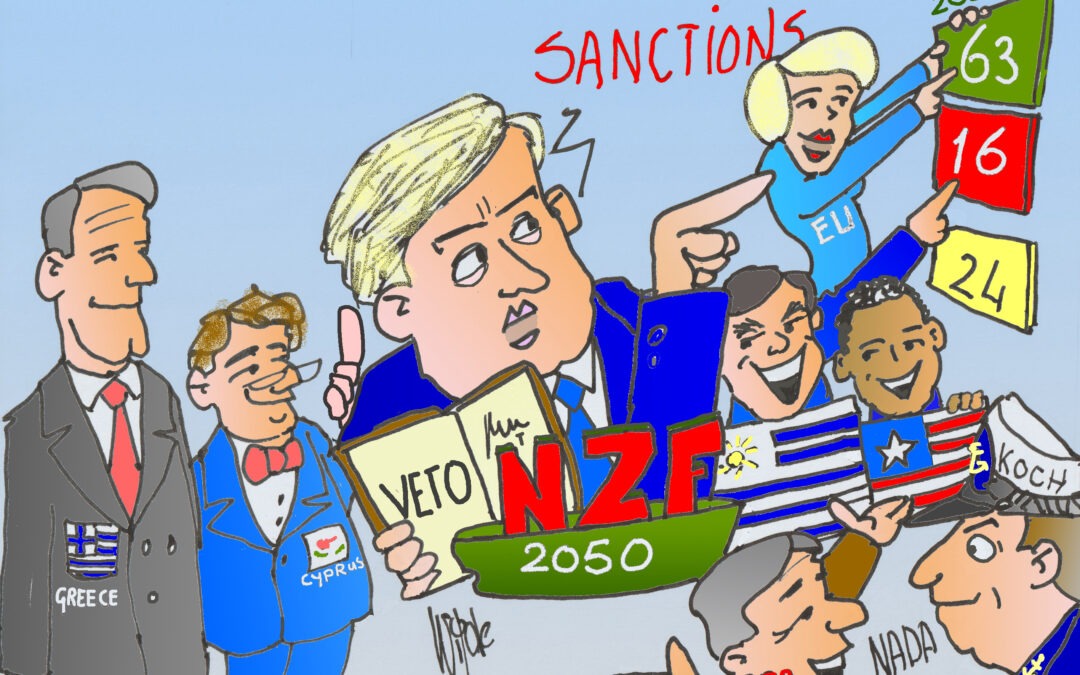
The provisional NZF agreement received the support of 63 member states, while sixteen voted against it. No fewer than 24 states abstained. However, one of the agreement’s greatest weaknesses was the US delegation’s withdrawal from the negotiations in protest. The Americans did not even take part in the vote, but their position was clear. The draft treaty was due to be formally adopted at the meeting in October last year. However, following fierce opposition from the US and, in particular, oil-producing states, a vote of 57 to 49 resulted in the decision being postponed by one year.
Also read: Trump threatens to sabotage clean shipping
Overlapping costs are piling up
Meanwhile, the Trump administration has continued to oppose the pricing mechanism included in the NZF. This resistance risks exposing shipping companies to an increasing number of overlapping fixed costs. In Europe, for example, international shipping is already covered by the EU Emissions Trading System, while FuelEU Maritime has introduced requirements governing the greenhouse gas intensity of ships calling at EU ports.
The Trump administration’s opposition also undermines the authority of the IMO, something the shipping industry itself is keen to avoid. Meanwhile, maritime organisations and other stakeholders continue to stress the importance of maintaining a common international regulatory framework for shipping, particularly now that the sector faces the practical challenge of decarbonising a fleet operating worldwide. Shipowners primarily want clarity about the rules their vessels must comply with, rather than having to meet different requirements in different parts of the world.
Economic retaliation
None of this seems to concern Trump. Last year, he threatened retaliatory measures against countries supporting the NZF, including visa restrictions, higher port fees and sanctions. So far, these threats have not materialised, but with such an unpredictable president, nothing can be ruled out.
Meanwhile, the opposing camps are becoming increasingly entrenched. European countries, Pacific island states and others support the treaty. The US, oil-producing states and countries such as Argentina and Liberia, which has a major shipping register, are leading the opposition.
Trump and his allies’ resistance to a global levy on shipping’s CO2 emissions has also fuelled criticism from environmental NGOs such as Transport & Environment and Opportunity Green. In an attempt to overcome the opposition, Japan proposed a compromise under which the NZF Fund would be replaced by an IMO scheme requiring polluting ships to purchase credits from cleaner vessels. Once these credits are no longer available, they would have to pay a levy to the IMO. The organisation would then use the proceeds exclusively to subsidise research and development projects for cleaner fuels and propulsion systems selected by the shipping industry itself.
Also read: Ports suffer from industrial malaise and Trump tariff war
No compensation for climate damage
Under this proposal, all levy revenue would remain within the shipping sector rather than being used to help developing countries recover from climate-related damage. Environmental organisations therefore strongly criticised the plan, arguing that it would do too little to reduce shipping’s CO2 emissions and allow those responsible for climate damage to escape accountability. They also warned that it would transfer power from states to large companies, which would use the revenue primarily to serve their own supply chains and infrastructure, rather than the needs of the global shipping industry and climate-vulnerable developing countries.
Under pressure from environmental organisations, the shipping industry has long been sensitive to accusations that it contributes to climate change. Shipping is estimated to account for three per cent of global CO2 emissions. However, influenced by climate-sceptic Trump, this consensus now appears to be shifting. Major shipping nations, including Panama, Liberia, Greece and Cyprus, are increasingly prepared to criticise the structure of the NZF.
The entire NZF is based on the premise that making fossil fuels sufficiently expensive will automatically make the production of alternative fuels economically viable. However, that process is still in its infancy, and remains economically unfeasible unless cargo owners are prepared to contribute to the additional costs. Large shipping companies are better placed than smaller operators to negotiate this type of arrangement with their customers.
Consequences for consumers
At the Capital Link Japan Maritime Forum, held on 16 October at the Tokyo American Club, the CEO of a small shipping company, Captain Eberhard Koch of OL Shipping (four vessels), pinpointed the problem. What is the point of imposing CO2 levies before sufficient alternative fuels and the necessary infrastructure are available? According to Koch, the system places a disproportionate financial burden on smaller shipowners and fails to take sufficient account of the commercial and operational realities of shipping, reports cbn.com in an article published on capitallinkshipping.com.
According to the same report, Greek Shipping Minister Vasilis Kikilias pointed out that ‘whatever happens at sea has consequences for greengrocers, supermarkets and household budgets.’ Ultimately, therefore, it is consumers who will pay. The Greek minister says he supports the environmental objective but questions the pace of the transition: ‘The pace towards 2050 and 2100 must be such that society can cope with it, and so can economies.’
Taking into account all the discussions, alternative proposals and last-minute attempts to find a compromise, I would be surprised if the NZF 2050 emerges from the meeting in early December unscathed. Everything suggests that the decision will have to be postponed by at least another year, a view now also shared by the International Bunker Industry Association (IBIA). And they should know: IBIA members are responsible for supplying the cleaner fuels that shipping is expected to use. According to the association, those fuels simply are not available yet, and will not be for some years to come.
Cartoon by Hans de Wilde/SWZ|Maritime.
Also read: EU is raising taxes, whilst Chinese industry reaps the real profits