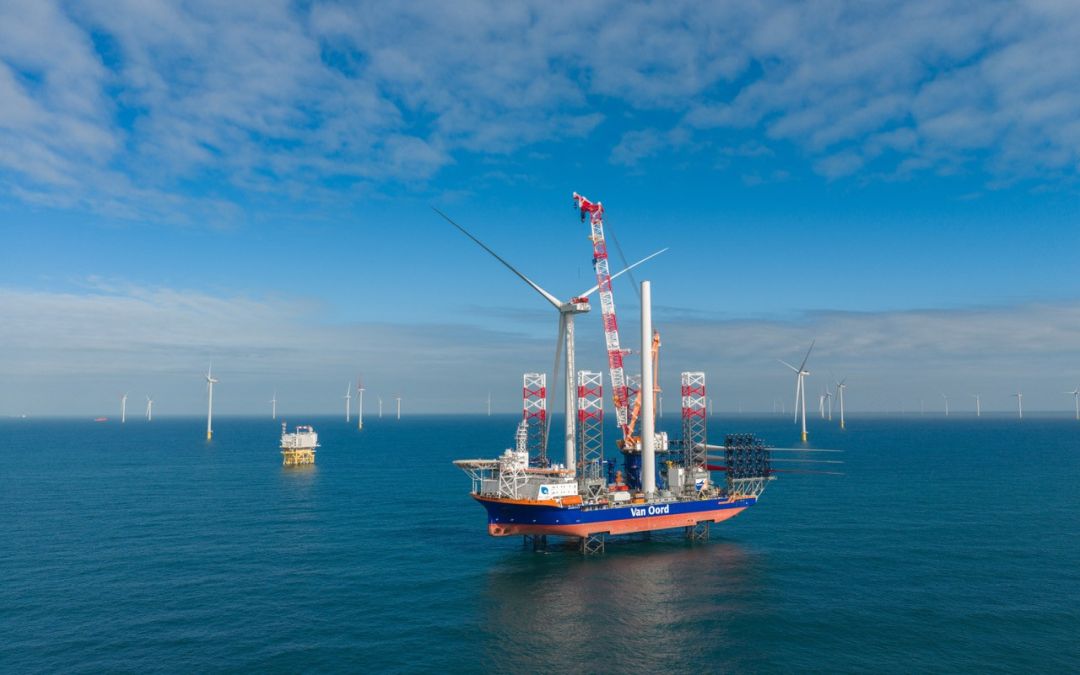
The last of the 52 wind turbines at the Ecowende offshore wind farm was installed on 30 October. With this milestone, Ecowende enters the final phase of construction.
The turbine stands approximately 53 kilometres off the coast of IJmuiden, in the Hollandse Kust (west) wind farm zone, Lot VI. The wind farm is expected to be operational by the end of 2026.
The Ecowende wind farm will have an installed capacity of approximately 760 MW, enough to supply around three per cent of current Dutch electricity demand. First power was already generated in July 2026.
Also read: Pipe lifting tool lands Van Oord IADC Safety Award
15-MW turbines
The first turbine was installed on 30 May of this year, meaning all 52 turbines were installed in less than five months. Vestas supplies the V236-15.0-MW turbines and is responsible for their installation and commissioning. Van Oord transports the turbines from Eemshaven to the offshore site using its installation vessel Boreas. Van Oord previously installed the foundations and the inter-array cables.
‘The successful deployment of our new offshore installation vessel Boreas shows what the vessel can achieve in this complex installation campaign. We achieved this result thanks to close collaboration with Ecowende, Vestas and all other partners involved,’ says Jan Willem Elleswijk, Project Director, Van Oord.
Also read: Van Oord and Ecowende kick off eco-fiendly scour protection
Ecology as a design principle
Ecowende aims to build one of the most ecologically considered wind farms to date. The wind farm is being developed by Ecowende, a joint venture of Shell, Eneco and Chubu, with ecology taken into account from the very start of the design.
For example, a bird corridor has been created within the wind farm, between the coast and the Natura 2000 site Brown Ridge (Bruine Bank). In this area, the turbines are spaced further apart. In addition, some nacelles have been installed at a greater height, giving seabirds more room to fly beneath the rotor blades.
Ecowende also uses an adaptive curtailment regime that responds to prevailing conditions, as well as radars with AI-based species recognition. These systems are used to reduce risks to birds and bats.
On seven turbines, one rotor blade has been painted red. The colour contrast is intended to make the rotating blades more visible to birds. Whether these measures actually lead to fewer collisions has not yet been demonstrated, which is why Ecowende is studying this in practice.
Henrik Andersen, CEO Vestas: ‘Ecowende demonstrates that offshore wind can deliver secure, affordable and sustainable energy while advancing our understanding of how renewable energy infrastructure can coexist with nature. The project will generate valuable insights for the wider industry and help inform how future offshore wind projects are developed.’
Also read: Van Oord unveils names of new flexible fallpipe vessels
Boosting biodiversity underwater
Various ecological measures are also being applied and tested underwater. Around the turbine foundations, Ecowende is testing different scour protection designs. Four monopiles are being fitted with additional water-exchange holes, where fish can find shelter.
At four cable crossings, reef structures made from old fruit trees, known as tree reefs, will be placed. In addition, oyster nurseries are being installed to help bring back the European flat oyster to the Dutch North Sea, where the species has declined sharply since the 1950s.
‘With the final turbine in place, the offshore wind park is largely complete, but the real learning begins now. Ecowende is designed to gain knowledge on how to build and operate a wind park in harmony with nature. We will share that knowledge, so that researchers, governments and wind park developers can build on it,’ concludes Tjalling de Bruin, CEO, Ecowende.
Picture: Van Oord’s Boreas installing the last turbine at Ecowende offshore wind farm (photo Van Oord).
Also read: Ecowende contracts Van Oord to build most ecological wind farm yet