From the magazine – There was no whirring of CNC machines, the workshops were empty and no team was present. The otherwise lively Dream Hall at the TU Delft was silent. The Dream Teams of the academic year ’25-’26 are celebrating their holidays and new teams had yet to start. In this empty Dream Hall, I met with Jiswi Wensink (21 years old) in mid- August to look back at the performance of the TU Delft Hydro Motion Team at the Monaco Energy Boat Challenge and his experiences as the team’s chief engineer.

This article is part of our Young talent series “Engineering the future fleet”. This article was first published in our September 2026 issue. All articles in this series are written bij SWZ|Maritime editor Bas Lenferink.
Working with boats was not his dream job from a young age, but a focused study direction and a challenge in the study programme led Jiswi to choose the Bachelor’s degree in Maritime Engineering at the TU Delft. There, his interest in maritime was piqued.
Jiswi: ‘After finishing high school, I wanted to study Mechanical Engineering, as I wanted to build stuff. For a moment I hesitated between a university of applied sciences and a research university, but I chose the latter because I wanted to challenge myself. Looking at different studies, Maritime Engineering drew me because of its focused study direction. I did not really have a passion for boats, although I worked at a small yard that built small pleasure boats. During my Bachelor’s I liked courses that combined both mathematics and physics. When I applied for both the Dream Team Hydro Motion and another Dream Team, I chose Hydro Motion when I got the opportunity.’
Engineering the future fleet
The maritime sector is developing quickly and new technologies arise. The industry is implementing new fuels in ships, automation plays an ever-increasing role in all parts of the sector and the rise of AI is changing the way we look at a lot of processes. In this returning feature, “Engineering the future fleet”, we dive into the world of young engineers and find out what they are working on and, more importantly, what is driving them.
Also at the start of your maritime career, or working at a start-up or scale-up? And do you have a story to tell? Contact SWZ|Maritime, redactie@swzmaritime.nl
The role of chief engineer was a deliberate choice. ‘I decided that I wanted to have a position where I could really develop myself in different ways. I might want to start my own company later, so I saw this as a good opportunity to learn. Within Hydro Motion, you can lead an engineering department or become chief engineer, head of all of the engineering. As chief engineer you are not looking at every drawing or every calculation, but you keep track of the engineering as a whole. This drew me in and I applied for this role. After a year, I can say that I don’t know every calculation, but I do know everything that’s in the boat. I really enjoyed this,’ Jiswi explains.
Also read: Safety by design – Engineering the future fleet: Daan Buitenhuis
Making hard decisions
The first time all the boat’s components came together was during the testing phase of the project. Testing started in May and continued up until the beginning of July, only days ahead of the start of the race in Monaco. It took place on the Wantij near Dordrecht.
This year’s goal was to sail the race on liquid hydrogen with a working boil-off system. The team also designed new foils, and they wanted to implement banking turns when foiling. This was achieved in the last days before departure and the boat was able to make banking turns while foiling at top speed.
However, the team did not manage to sail on liquid hydrogen. Two weeks before departing for Monaco, the team decided to sail the race on hydrogen gas instead of liquid hydrogen. All the components including the boil-off system worked outside the boat, but there was not enough time to test them inside the boat and while sailing.
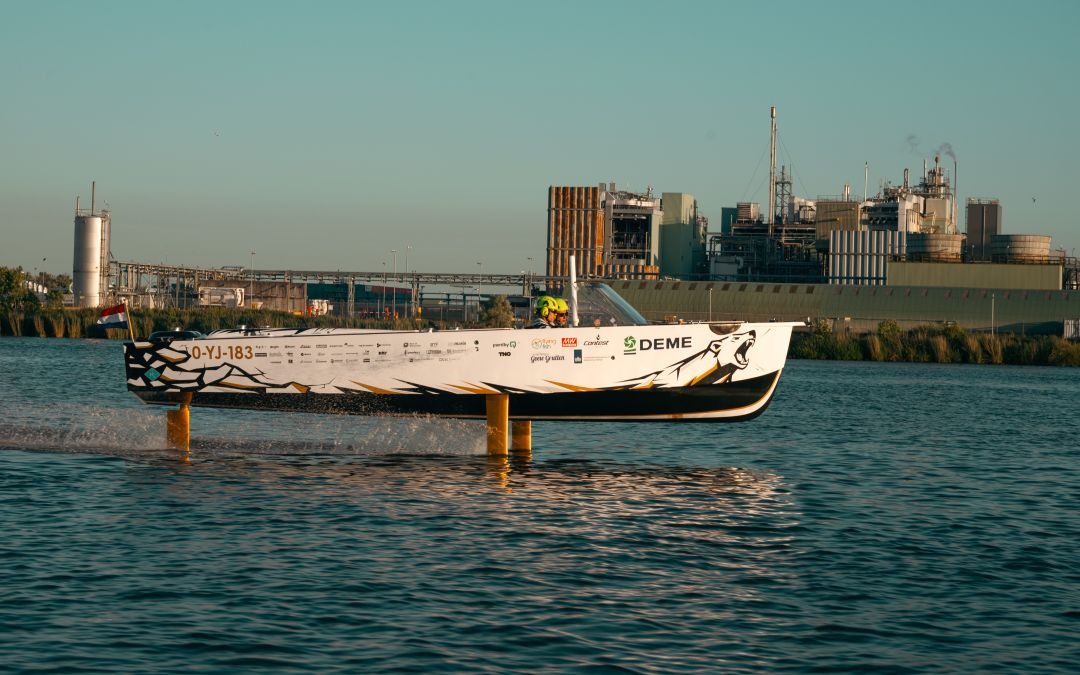
Jiswi recalls making big decisions like this as one of the biggest challenges of the year: ‘We decided not to sail on liquid hydrogen as we had a bigger chance of competing successfully in the race on hydrogen gas than of successfully managing to sail on and test liquid hydrogen in just a few weeks’ time. During the year, you have to make decisions that not everyone likes or understands. As chief engineer, I had to make some of these choices with management or the department chiefs.’
He adds: ‘You first experience this at the start of the year when management starts one week ahead of the rest of the team and has to make choices regarding the whole team without much more experience than the others. Then there are also days with successes after a hard day’s work where you might want to continue into the late hours, but you have to decide to stop to keep safety in mind. You make good and bad decisions. In the end, things always could have gone better, but a lot of things went very well.’
Also read: Pushing boundaries – Engineering the future fleet: Casper Koopman
Bad weather and breakdowns
Bad weather and technical breakdowns prevented a good result for the team in Monaco. During the opening parade, the boat hit something underwater and broke one of the foils. The team was able to recover the foil, but they had to sail the first two races without them. ‘The first two races went fine without the foils, we were still going relatively fast. However, the commentator was not aware that our foil broke, so he was wondering when we were going to start foiling.’
A long night of constant work on the boat enabled the team to start the next race with foils, although the weather soon had a negative impact. ‘We finished the work on the boat just in time for the start. The conditions of the race were very bad and the race organisation had already shortened the race from sixteen nautical miles to six. 2.5-metre waves then caused the foils’ sensors to read unusual values, so they blocked movement of the foils and the boat took a dive into the sea. We were able to finish second, but only two boats finished in the end because of the weather.’
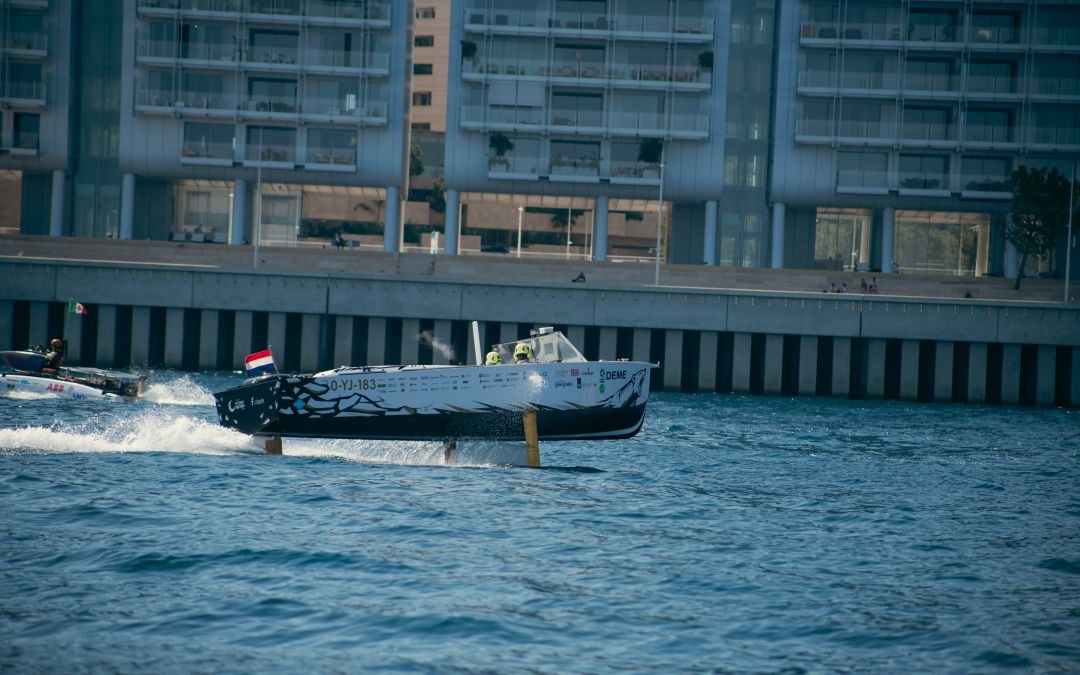
The next day it became clear that the bad weather had caused more problems. When preparing for the endurance race, a part of the race the team had high hopes for, the team noticed that a circuit in the boat had shorted because of water that had entered the boat unnoticed. The team was not able to start the endurance race. The race itself was later cancelled after three rounds because of the weather conditions. Ultimately, Jiswi is pleased with the results: ‘I saw the boat foil in Monaco the day before the races and we were also able to do banking turns. That was really nice to see.’
Also read: Liquid hydrogen as the fuel of choice
New team
The new team just started working and is now determining their goals for ’26-’27. Groups of alumni support the new team and help to prevent them from making the same mistakes as previous years.
TU Delft Hydro Motion Team
The TU Delft Hydro Motion Team is one of the so called “Dream Teams” of the TU Delft. Located in the Dream Hall on the campus, the teams work on innovative concepts. With limited funds and only one year to finish the projects, each team is trying to achieve the best results. The goals of these teams vary from building an exoskeleton that allows paralysed people to walk, to developing a liquid hydrogen-powered boat.
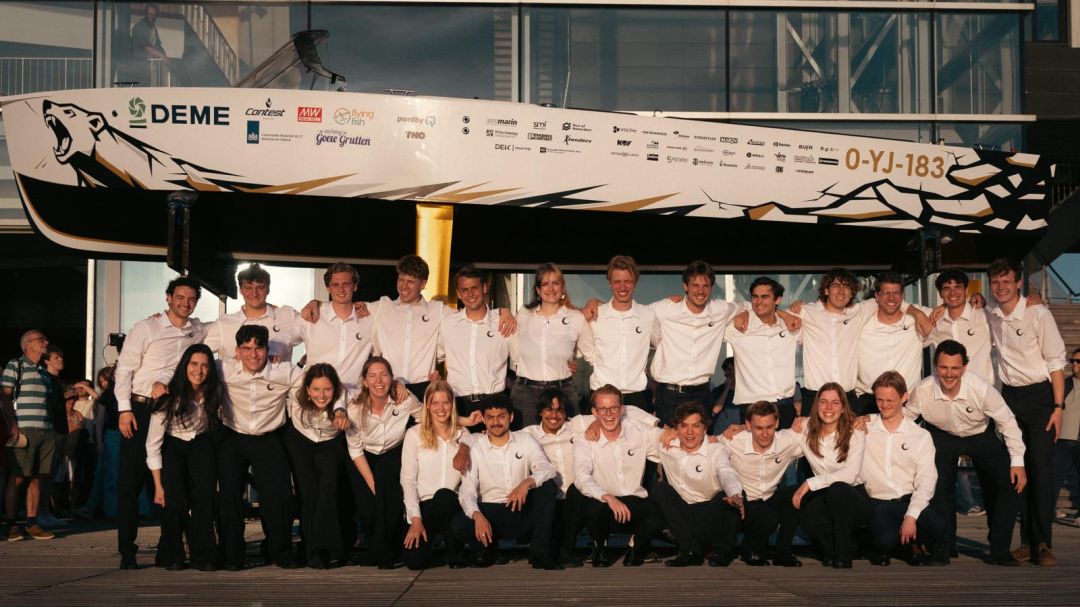
Hydro Motion’s goal this year was building a foiling liquid hydrogen-powered boat and win the Monaco Energy Boat Challenge. 26 students were working mostly full-time to achieve this goal. SWZ|Maritime has been following the team with the feature Engineering the future fleet. Read the previous interviews for a more detailed description of their goals and the technical challenges they experienced. SWZ|Maritime spoke with team manager Pépé Becx for the March edition and chief of the powertrain department Daan Buitenhuis for the June edition.
For Jiswi, this project made one thing clear: ‘I really liked diving into the deep end with the project and working on the management side. In hindsight, I would like to do some things differently and continue working on the project. When you have your own company I can imagine that you experience similar things. And in that case, you can continue working on the project for let’s say another thirty years.’ Another boat by Jiswi might very well be on the horizon.
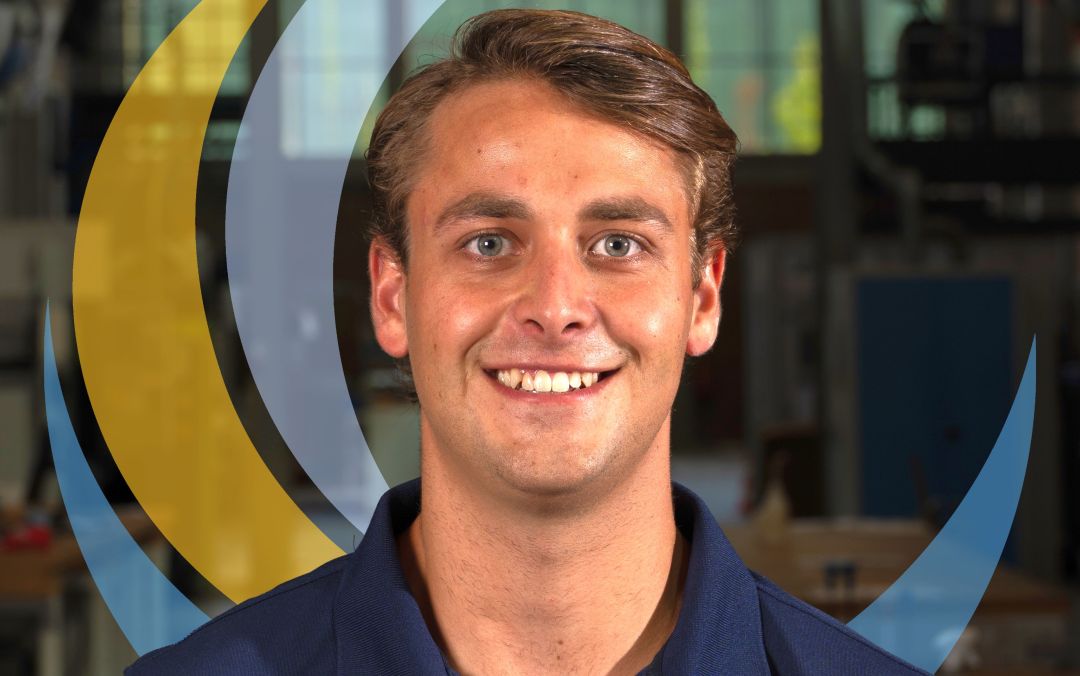
Picture (top): Jiswi Wensink: ‘In the end, things always could have gone better, but a lot of things went very well’ (all photos TU Delft Hydro Motion Team).