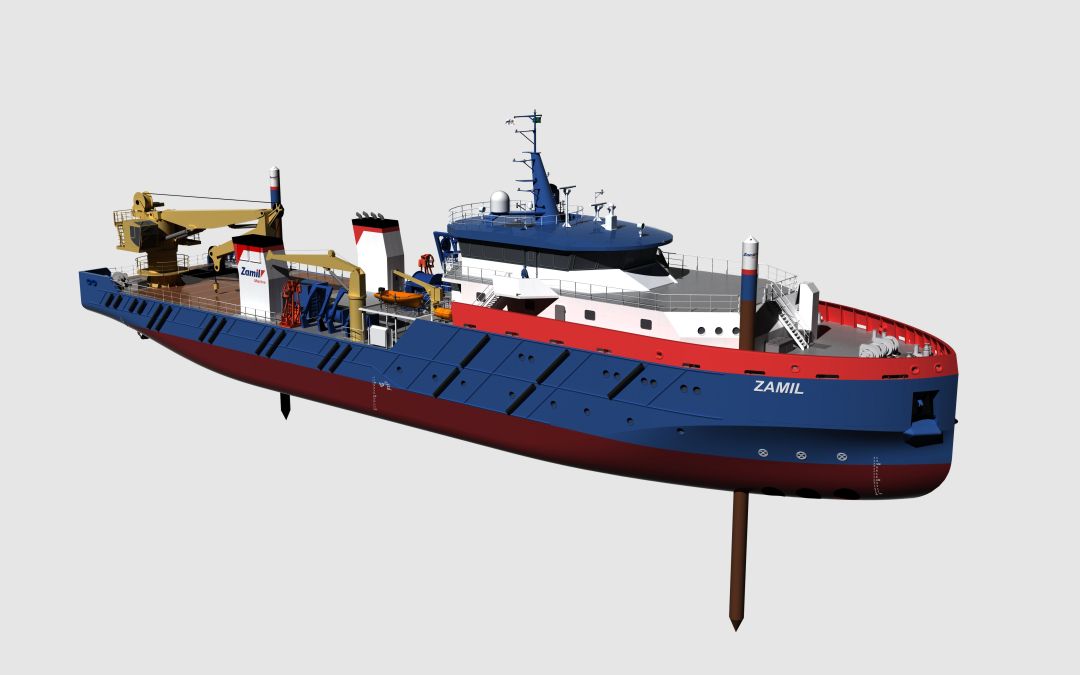
Zamil Offshore has contracted Conoship International to design a dive support vessel (DSV) with a shallow draught of 2.5 metres. The vessel has been designed in such a way that the limited draught does not compromise operational capabilities or fuel efficiency.
Offshore operations in shallow waters often create operational trade-offs for vessel owners. Subsea infrastructure maintenance demands heavy-duty mission equipment, including dynamic positioning (DP2), integrated diving systems, deck cranes, and compliance with the Special Purpose Ships (SPS) Code. Existing vessels commonly feature draughts that restrict them from accessing shallow water.
The new DSV has been designed to address this operational constraint in the Gulf Region. Conoship executed both the concept and basic design phases of the design.
Also read: Conoship reveals battery-electric CIP vessel design
Hydrodynamic efficiency and shallow water access
Designing a DSV with a limited draught requires close attention to structural weight, stability, and resistance. That is why Conoship focused on a lightweight structure, hull-line optimisation, stability and low resistance. CFD analysis and tank testing were used to minimise hull resistance and optimise water flow to the propulsion system, reducing fuel consumption.
The vessel has a 360-m² reinforced working deck for heavy deck cargo and a knuckle-boom crane with a 22-metre reach and 20-tonne capacity. Dive support is provided by a dedicated diving deck and control room equipped with LARS, ROV and other dive support systems. Station keeping is provided by a class 2 DP system or twin spud poles in shallow-water operations. Five dry bulk tanks allow the vessel to supply cargo to offshore operations.
The design was developed for Zamil Offshore to support subsea infrastructure and maintenance work in regional oil and gas operations. Its lightweight hull and optimised lines, combined with diesel-electric propulsion for DP operations, provide low fuel consumption, reduced emissions and lower operating costs without compromising operational capability.
Also read: Conoship adds container feeder to short-sea portfolio
Tailored design
Zamil Offshore required a modern, highly specialised asset to support subsea infrastructure operations, including maintenance for regional oil and gas installation. Rather than adapting an “off the shelf” design, Zamil sought a state-of-the-art vessel built around low fuel consumption, efficient maintenance, and high operational reliability.
The design complies with ABS Class rules and the SPS Code. This confirms that specialized operational capabilities can be integrated into a shallow draft profile. Conoship’s scope covered the full Concept and Basic Design packages, delivering a complete engineering package suited for yard selection and construction.
This collaboration reinforces Conoship’s experience in custom naval architecture and specialized offshore vessel engineering.
The main characteristics of the DSV are:
- Length: 76.20 m
- Beam: 17.00 m
- Draft maximum: 2.50 m
- Deadweight: approx.. 950 tons
- Dynamic positioning: DP class 2
- Accommodation capacity: 76 persons
- Propulsion: 2 x Azimuth thruster
- Deck equipment: 22m – 20 t knuckle-boom crane
- Dive equipment: LARS, ROV, and dive support systems
Picture: For the diving support vessel Conoship focused on a lightweight structure, hull-line optimisation, stability and low resistance (image Conoship).
Also read: Wilson orders eight Conoship-designed CIP6300 short sea vessels