Wooden sailing vessel Batavia was transported to and installed at its final resting place in Lelystad on 2 October. The 1995-delivered, full-scale reconstruction of the 1628 Dutch East India Company ship had been prepared for its final voyage at Damen Shiprepair Amsterdam.
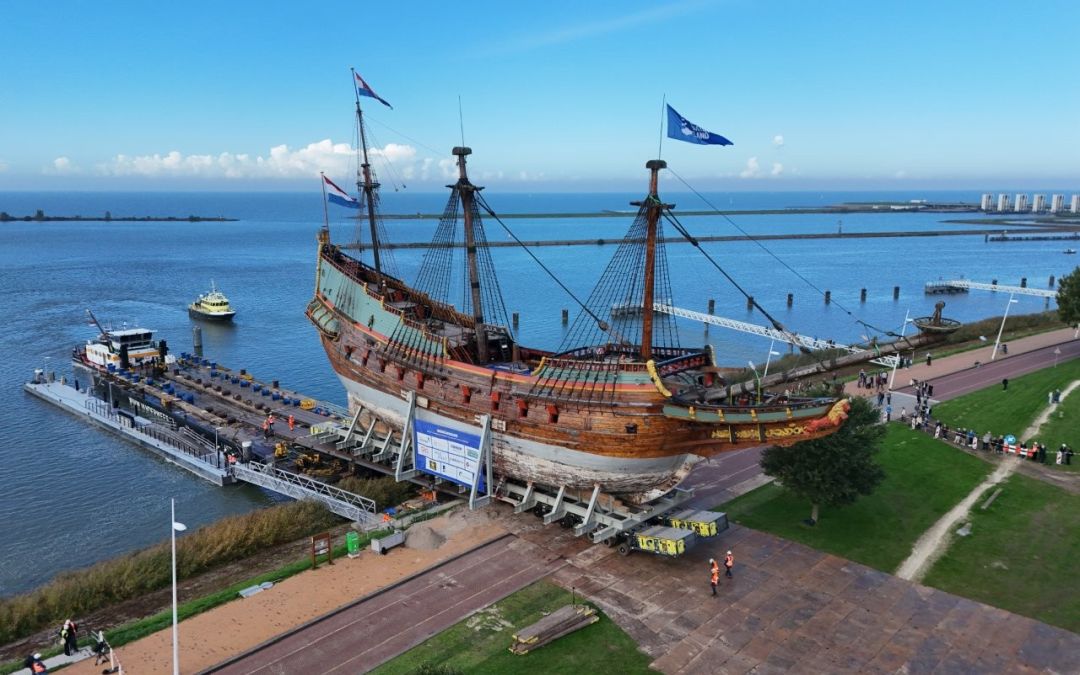
It was transported on a specially built cradle, placed on a pontoon, and driven ashore at Museum Batavialand, Lelystad. Two SPMT trains of 28 axle lines each took the 646-tonne wooden ship and its 101.2-tonne cradle off a pontoon, up a purpose-built ramp, across the Markermeer dike and 250 metres onto the grounds of Museum Batavialand. The next day, the jacking system lowered the ship onto its permanent concrete foundation.
Ten months of engineering
Q3 Heavy Lift built up the two SPMT trains in Dordrecht and shipped them on a small pontoon to Amsterdam, where they drove onto the main pontoon and took up position beneath the cradle. The axle count is driven not by the weight, but by the stiffness requirement: 56 axle lines spread the load far enough along the cradle to keep it from deflecting under a vulnerable, over thirty years old wooden hull that cannot tolerate being worked.
The load paths were modelled in detail during ten months of engineering. This established where the Batavia is strong enough to carry support and how high each support point had to sit.
Also read: VIDEO: Batavia replica ship arrives at Damen Shiprepair
A 250-metre route surveyed metre by metre
The pontoon was trimmed to meet a prepared ramp, with load-spreading and crane mats laid to carry the trains across the dike footpath. The dike itself was the governing constraint, as the land behind it lies well below sea level. The technical partners closely collaborated with the Directorate-General for Public Works, the Water Authority Zuiderzeeland, the Province of Flevoland and the Municipality of Lelystad.
The ramp was built deliberately long to keep the approach angle shallow and the ground pressure as even as possible. Q3 Heavy Lift set out the driving path in advance, including ground pressures, subsoil conditions and buried services. Lamp posts and street furniture along the route were removed and will be reinstated.
Coming off the pontoon, the trains made a turn and reversed the ship into position, again a manoeuvre preceded by soil investigation along the full route. ‘It is only 250 metres, but if you drive over a pipeline you didn’t know was there, you have a problem,’ says Ard Suvaal, Project Manager at Trans Global Projects, which held project management, risk analysis, permitting and public safety for the operation. ‘That groundwork is what makes the difference on a job like this.’
He adds: ‘We move large steel structures for a living – transformers, oil and gas, offshore. Usually, almost nobody sees those projects and it usually just inconveniences local people along the route. This time we have a reconstruction of a seventeenth-century VOC ship standing on the trailers, in full public view and with a lot of guests and media watching the operation. I am proud of that.’
Eight metres higher than before
On its new position, the Batavia stands more than 8 metres higher than at its old berth at the museum’s quayside, making it visible across the surrounding area. The move is intended to preserve the ship for the long term: ashore, the timber can dry, the hull is better protected from the weather and maintenance can be carried out properly. The Batavia will form the centrepiece of the redeveloped Museum Batavialand, due to open at the end of 2028.
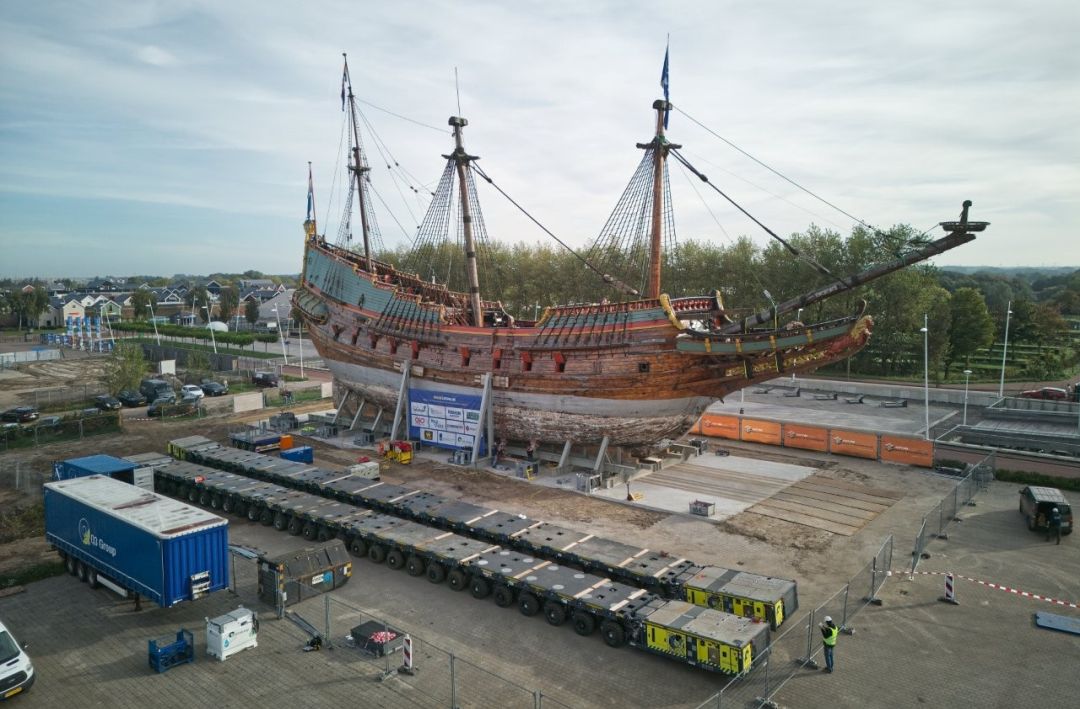
The dimensions of the Batavia are: LOA 56.6 metres, LBP 45.3 metres, beam 10.5 metres, air draught 30.5 metres, draught 3.8 metres. It was built at Lelystad between 1985 and 1995 under shipwright Willem Vos with more than 600 vocational trainees. The cradle upon which it rests measures 39.7 × 15.5 metres and weighs 87.2 tonnes plus 14 tonnes of wood.
Picture (top): Batavia moving onto land (photo Peter van Aalst).