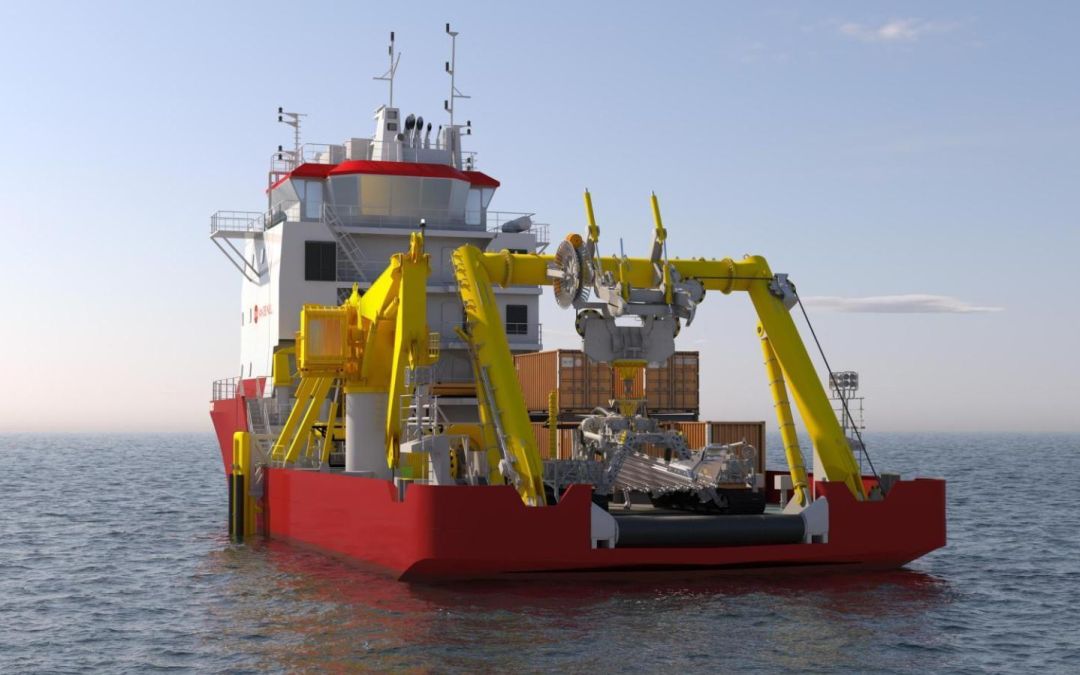
By the end of 2026, Crayfish will join the Jan De Nul fleet of trenchers. This new subsea robot can bury cables up to five metres deep in the seabed and is ideally suited for working in shallow waters, closer to shore. Once completed, Crayfish will have a permanent home aboard Henry Darcy, which is currently being converted into a trenching support vessel.
Like the Swordfish, which Jan De Nul uses to bury cables in deep waters, the company ordered Crayfish from British engineering company Osbit. Capable of burying cables in water depths of up to 200 metres, the trencher can be deployed flexibly, both offshore and onshore. Thanks to its lightweight design and modular build, Crayfish has a limited impact on its surroundings. Its modular design also makes it easy to transport and mobilise from one project to another.
Also read: Jan De Nul completes Brazil’s largest-ever beach strengthening
Conversion of Henry Darcy
Crayfish is remotely operated from the shallow-draught vessel Henry Darcy, which is currently being converted into a trenching support vessel. Before its conversion, Henry Darcy was a water injection dredger, using high-pressure water to loosen the seabed and move sediment.
Today, part of this former equipment is being given a new purpose. The water pumps previously used for dredging will supply high-pressure water to Crayfish. The jet water is fed from the vessel to the trencher through a hose, allowing Crayfish to loosen the seabed and bury the cable.
This smart combination makes Crayfish particularly well suited to shallow waters. On most trenchers, the jet pumps are located on the machine itself, but they cannot operate in very shallow water. On Crayfish, the pumps are located aboard Henry Darcy, allowing the trencher to work much closer to shore.
Also read: Jan De Nul lands 25-year Argentine waterway concession
First deployment in 2027
Crayfish will be deployed for the first time in summer 2027. In the German North Sea, the trencher will bury cables in shallow waters as part of the 2 GW cable programme Jan De Nul is carrying out for grid operator TenneT.
The arrival of Crayfish is part of a series of recent investments in the expansion of the company’s subsea cable fleet. It will strengthen Jan De Nul’s capacity to install and protect subsea cables and further contribute to the development of infrastructure for renewable energy at sea.
Picture: Trencher Crayfish on the Henry Darcy (image Jan De Nul).
Also read: Jan De Nul reports record turnover over 2025