Leafing through this issue, it’s tempting to see unrelated stories: a methanol retrofit in Shanghai, uncrewed barges in Antwerp, a carbon capture trial on a tanker, a record orderbook, a press conference in Hamburg. Read together, though, they show the same industry attacking the same problem from three directions at once — all converging on SMM this September.
The first road is the fuel itself. COSCO Shipping Libra’s conversion to methanol shows that decarbonising the existing fleet is no longer theoretical — it is 108 days in a Chinese drydock, hard-won lessons on phased construction, and 456 fewer TEU per voyage. Sister vessel Gemini’s retrofit took just ninety days: the real story is the learning curve, now being applied to Seaspan and, potentially, MSC.
The second road runs through the exhaust stack rather than the fuel tank. Onboard carbon capture lets ships keep burning what they already burn while still cutting emissions. Results from the Carbon Ridge trial on the STI Spiga, and SMDERI’s mineralisation approach, suggest this is closer to commercially viable than a year ago. A pragmatic answer for the roughly ninety per cent of the fleet that cannot switch fuels overnight. At the same time, it may give LNG a longer life than expected.
The third road is not about what powers the ship, but who, or what, runs it. The River Drones in Antwerp show automation is already moving cargo through Belgian locks today, under a legal framework that has not caught up.
Also read: SWZ|Maritime’s June 2026 issue: Who’s steering?
Moving together
Behind all of it sits the orderbook: a record in CGT terms, dominated by China as never before, with owners committing to newbuildings even as the rules for what those ships will burn and who will crew them remain unsettled.
That tension is exactly what SMM 2026 is built to address. As Claus Ulrich Selbach, Vice President Exhibitions Maritime & Energy at Hamburg Messe und Congress, put it ahead of the show, the most interesting developments now emerge at the intersections between sectors — where fuel strategy, automation, and regulation meet. None of these three roads gets there alone. Each depends on builders, owners, class societies, and suppliers moving together, and fast. Hamburg, the first week of September, is where that conversation continues.
This is editor-in-chief Robin Zander’s editorial accompanying the July-August 2026 issue.
Also read: SWZ|Maritime’s May 2026 issue: Always the skipper
SWZ app and archive
Our digital archive is available to subscribers both online and in our new app (available for Android and Iphone) and they can read the digitial version of our July-August issue there. Not yet a subscriber? Visit our subscription page.
Also read: SWZ|Maritime’s April 2026 issue: Dredging reimagined
The articles in SWZ|Maritime’s July-August issue
In addition to the regular sections such as Dutch news, Global news, Markets, book reviews, KNVTS news and Mars Report, the July-August issue features the following articles:
- World shipbuilding orderbook continues to grow
- SMM: Focus on efficiency, innovation and resilience
- Is OCCS technology on the verge of a breakthrough?
- Bulk cargo liquefaction – Why is it still happening?
- Reliable roll natural period measurements made easy
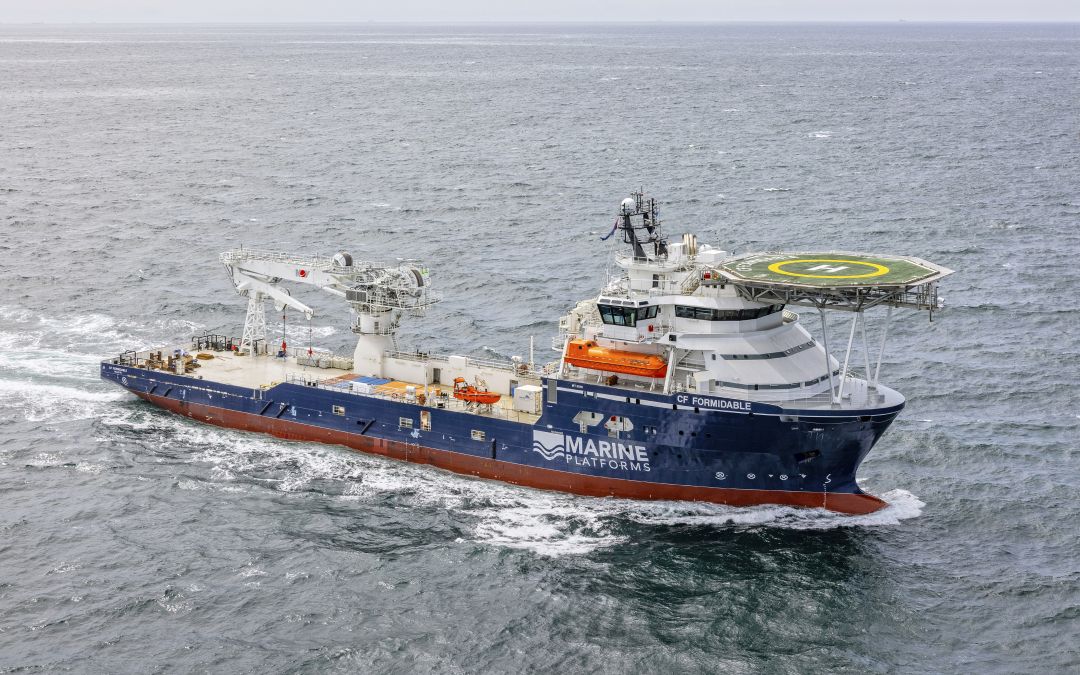
- Ship in detail: CF Formidable
- Retrofitting at scale
- Semi-autonomous operation has already arrived
- CEDA – Dredging Days – It’s a zoo out there!
- CEDA – The marine minerals paradox
Picture: With deepwater Construction Support Vessel CF Formidable, Chevalier Floatels scales up from accommodation vessels (floating hotels) and walk-to-work vessels into the field of actual working ships (photo by Flying Focus, cover picture of SWZ|Maritime’s July-August 2026 issue).
Also read: SWZ|Maritime’s March 2026 issue: Imagine