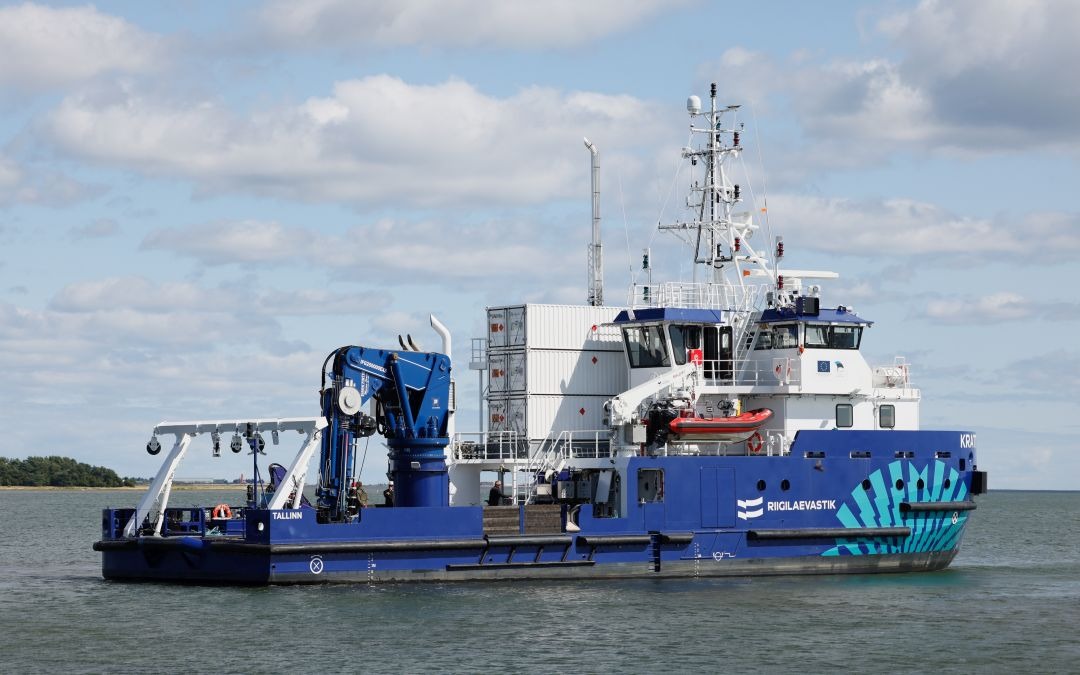
Estonia has completed a 38-metre multi-purpose workboat powered by compressed biomethane (CBM) and battery-electric propulsion. Built by Baltic Workboats for the Estonian State Fleet, the vessel combines low-emission propulsion with the versatility of a modern state workboat.
The christening ceremony took place on 12 August 2026 in Saaremaa, Estonia. Kuldar Leis, Minister of Infrastructure of Estonia, and key representatives of Estonia’s maritime sector and shipbuilding industry attended the ceremony.
Named Kratt, the multi-purpose workboat will enter service in Estonian waters this autumn, carrying out a wide range of maritime tasks, from buoy maintenance and fairway services to marine research, pollution response and rescue operations. Its flexible design enables one vessel to perform tasks that would traditionally require several specialised platforms.
Also read: Estonia puts €25M into green retrofitting of ships
Biomethane and batteries
Kratt is the first large workboat in Estonia as well as the nearby region to use compressed biomethane (CBM) as its primary fuel. At the same time, it is equipped with a 400-kWh battery system for electric propulsion and onboard power.
Powered by biomethane, the vessel can travel up to 1000 nautical miles at 7 knots. On battery power alone, it can operate for up to two hours at 5 knots. When at anchor, the battery system can provide electrical power for up to ten hours, reducing the need to run auxiliary engines and thereby lowering fuel consumption, emissions and noise.
The vessel is equipped with four 350-kW gas generators. Its maximum speed is 11 knots.
Leis: ‘This new vessel shows how a state fleet can become both more capable and more environmentally sustainable at the same time. We need to develop our fleet intelligently – one vessel should be able to perform as many different tasks as possible while doing so with a lower environmental impact. I am particularly pleased that this innovative workboat was designed and built here in Estonia.’
Versatile platform
Kratt’s primary operational tasks will include the seasonal maintenance and deployment of navigation buoys and fairway services. At the same time, the vessel provides a broad platform for modern marine research and environmental operations throughout the Baltic Sea.
The vessel can support environmental, oceanographic, hydrographic and geological research, including:
- water and sediment sampling;
- seabed sonar surveys;
- towing of research equipment;
- deployment and operation of remotely operated and autonomous systems;
- meteorological and biological observations;
- deployment and recovery of research equipment, containers, buoys and seabed stations.
A dedicated approximately 50-m2 wet and dry laboratory provides researchers with workspaces, sampling equipment, a seawater flow-through system and facilities for connecting and operating research instruments.
Also read: Class and flag state approval for fuel flexible Damen tug
Emergency response capability
Kratt will also strengthen Estonia’s maritime emergency response capability. The vessel will provide approximately 25 per cent of Estonia’s oil pollution response capacity and is equipped with mobile and portable equipment for pollution containment and recovery. Its multi-purpose configuration also allows it to support search and rescue operations and other state maritime missions.
The vessel can operate at sea for up to seven days without replenishing supplies. It provides accommodation for six crew members and up to ten researchers. In addition to the laboratories, it includes a mess, recreation and sports facilities, galley, office and utility spaces.
Built for Baltic Sea conditions
Despite its focus on sustainability and versatility, Kratt is also a robust working vessel capable of operating in challenging conditions. The vessel measures 38 metres in length and 10 metres in beam. It has an operating draught of 2.5 metres and a maximum draught of 3 metres. Its deck crane has a lifting capacity of 15 tonnes at three metres from the vessel’s side.
With an Ice Class 1C, Kratt is capable of operating in up to 40 cm of level ice at a speed of at least 2 knots, extending its operational capability beyond the summer season.
Also read: Wärtsilä joins EU project to boost zero-carbon shipping
Baltic Workboats
Baltic Workboats is an Estonian shipbuilder specialising in advanced workboats and specialised vessels. The company designed and built Kratt.
‘When building this vessel, it was essential to find a solution that combines high work capacity, versatility and a lower environmental impact,’ states Margus Vanaselja, Chairman of the Management Board of Baltic Workboats. ‘Combining biomethane and electricity offers strong opportunities to achieve this and makes the vessel unique in its solutions on a global scale.’
The vessel’s design integrates propulsion, research, deck machinery and operational systems into a single flexible platform, allowing it to be adapted to a wide variety of missions. The name Kratt refers to a legendary creature in Estonian folklore traditionally portrayed as tireless, industrious and capable of carrying out a wide range of tasks – qualities that reflect the vessel’s intended role.
Project and construction
The design and construction contract for Kratt was signed with Baltic Workboats in January 2024. Damen Shipyards Gdańsk in Poland won the subcontract to build the vessel’s hull, where it was completed and launched in autumn 2025. After transport to Estonia, Baltic Workboats completed the vessel’s outfitting, systems integration and construction at its yard in Saaremaa.
The complete design and construction process took approximately thirty months. The total project cost was EUR 22 million, financed through the European Union’s NextGenerationEU Recovery Fund.
The particulars of Kratt are:
- Vessel type: multi-purpose workboat
- Length: 38 m
- Beam: 10 m
- Operating draught: 2.5 m
- Maximum draught: 3.0 m
- Maximum speed: 11 knots
- Primary fuel: compressed biomethane (CBM)
- Battery capacity: 400 kWh
- Gas generator capacity: 4× 350 kW
- Biomethane range: up to 1000 nautical miles at 7 knots
- Electric propulsion: up to 2 hours at 5 knots
- At-anchor battery operation: up to 10 hours
- Crane capacity: 15 tonnes at 3 m from vessel’s side
- Ice class: 1C
- Ice capability: up to 40 cm level ice at ≥2 knots
- At-sea endurance: up to 7 days without replenishment
- Crew accommodation: 6
- Researcher accommodation: 10
- Laboratory: approx. 50 m2 wet and dry laboratory
- Pollution response capacity: approx. 25% of Estonia’s national capacity
- Design & construction: Baltic Workboats, Estonia
- Vessel operator: Estonian State Fleet
- Financing: EU NextGenerationEU Recovery Fund
Picture: In addition to sustainable operation, Kratt has been designed for a multitude of tasks (photo by Robert Markus Liiv).