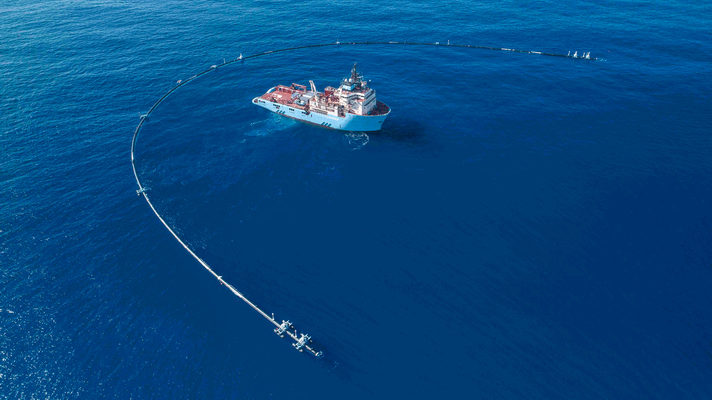
The Ocean Cleanup system has had to return to port earlier than planned due to one of its High Density Polyethylene (HDPE) floaters breaking down.
On Saturday 29 December, the offshore crew discovered that an 18-meter end-section had detached from the rest of the system during a regular inspection. Suspected cause of the malfunction is fatigue caused by about 106 load cycles) and a local stress concentration. The system will now return to Hawaii in the coming weeks for repairs which are expected to take a few months.
The Ocean Cleanup has stated both the 580-m main section and the 18-m end section are both stable; all bulkheads are intact, and the end section has two stabilisers affixed to it to prevent it from rolling over. Because no material was lost, there have been no safety risks for the crew, environment or passing marine traffic. However, as the redundancy in the cleanup system’s sensors and satellite communication (which are mounted on both end sections) has now been compromised, the organisation decided to return to port.

Picture: Blueprint of system, indicating the point of fracture.
Another Setback
It is another setback for The Ocean Cleanup after it discovered, soon after deployment, that plastic was exiting the system once it was collected. It moved too slowly over the ocean, causing the plastic to float away. The organisation is also looking for a solution to this problem.
CEO Remains Optimistic
CEO and Founder Boyan Slat remained optimistic: 'We are returning to port with terabytes of data that we will use in coming weeks and months to develop the necessary upgrades. The Maersk Transporter is also carrying around 2000 kg of plastic that we recovered from the patch over the past few weeks through a combination of the cleanup system and ghost net fishing (for comparison: once fully operational, System 001 is expected to harvest 1000 kg per week).'
'Although we would have liked to end the year on a more positive note, we believe these teething troubles are solvable, and the cleanup of the Great Pacific Garbage Patch will be operational in 2019. The fact that the cleanup system orients itself in the wind, is able to follow the waves well and is able to catch and concentrate plastic gives us confidence in the technology.'
Watch a video of the system's first results below.
Ocean Cleanup Technology
The Ocean Cleanup system was designed by now 24 year old Dutchman Slat, who came up with the system in high school. It consists of a 600-m-long floater that sits at the surface of the water and a tapered 3-meter-deep skirt attached below. The floater provides buoyancy to the system and prevents plastic from flowing over it, while the skirt stops debris from escaping underneath.
Both the plastic and system are being carried by the current. However, wind and waves propel only the system, as the floater sits just above the water surface, while the plastic is primarily just beneath it. The system thus moves faster than the plastic, allowing the plastic to be captured. Watch a video explaining the technology on our website.
Pictures by The Ocean Cleanup.