After fifteen years of extensive research, project partners Eidesvik Offshore, Wärtsilä Norway and DNV GL have announced the closure of the FellowSHIP project.
FellowSHIP aimed to explore the use of battery, hybrid and fuel cell technology in the maritime industry.
Exploration of Marine Fuel Cell Technology
The project partners started to explore marine fuel cell technology in 2003 and installed a prototype fuel cell on board Eidesvik Offshore’s Viking Lady PSV in 2010. While the fuel cell vision may have been ahead of its time in 2003, proof of concept and basic principles for maritime fuel cells were established that guided the industry through the next stages of development.
Hybrid Battery Power Systems
In the last phases of the FellowSHIP project, focus shifted to demonstrating the applicability of hybrid battery power systems, and the project signaled the charge to lithium ion batteries. Now, class rules have been established and the technology is fully commercialised; thus the partners have determined that it is time to decommission FellowSHIP.
Focus on Batteries
The shift in focus to batteries happened due to the slower response time of fuel cells as well as their capability to provide reserve power to meet redundancy requirements and to handle variable loads or peak shaving. Fuel savings were said to amount to fifteen per cent.
Other Advantages of Hybrid Power
The FellowSHIP project went on to document many other advantages of hybrid power in addition to fuel savings. Enhanced vessel performance, noise reduction and improved safety due to quicker response time were just some of the benefits achieved by combining battery power with fuel cell and LNG. Perhaps the most significant advantage has turned out to be emissions reduction.
FellowSHIP
Results from the FellowSHIP project were published internationally throughout the life of the project, contributing to the basic industry knowledge of hybrid battery systems. Bjørn-Johan Vartdal, Maritime Programme Director for Technology and Research for DNV GL Group, sums up: 'The field is open now. Each supplier will find their own battery hybrid solutions, but FellowSHIP proved it was possible.'
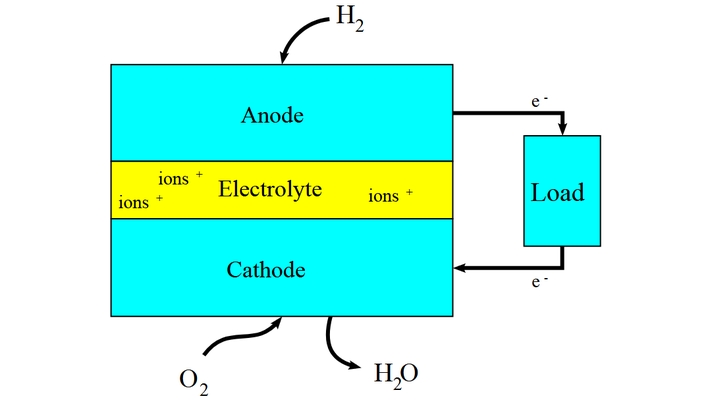
Picture: A block diagram of a fuel cell (by Paulsmith99).